Labour candidate keen to get back to basics and ‘fix SNP’s mess’

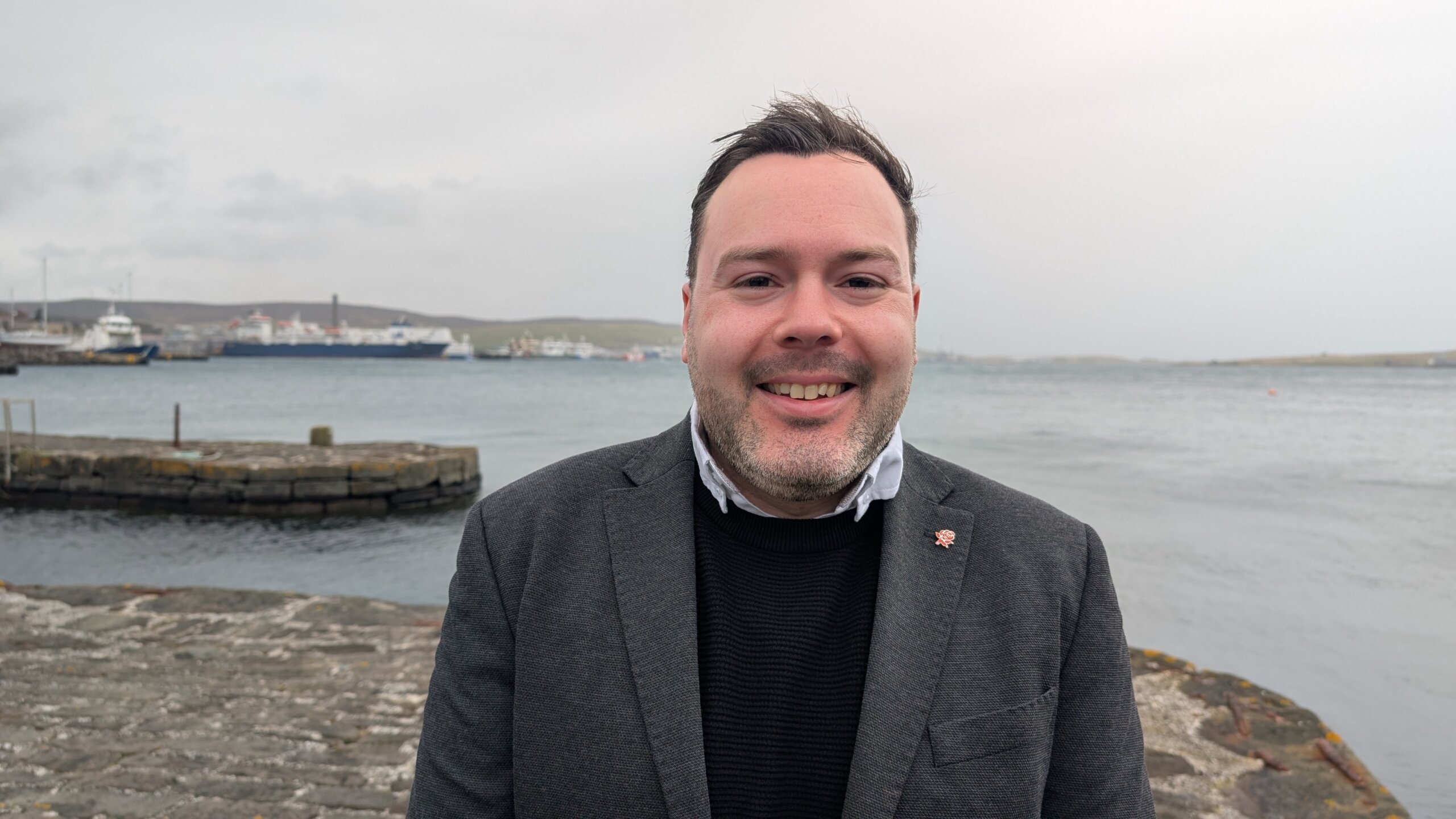
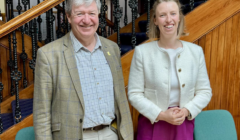
A PHRASE that keeps cropping up in Labour candidate John Erskine’s election campaign is getting “back to basics”.
It quickly makes an appearance too when Shetland News sits down with the 35-year-old in the Mareel cafe last week over a coffee.
“We have had 19 years of SNP government,” he says, “and I think things have gone backwards.
“Our public services, our schools, our hospitals have all declined over that period of time.
“For me, it is just about getting back to basics, fixing the mess and making sure that Scotland works again for people, and that includes here in the island communities.”
Strong words, but Erskine may be battling into a headwind already.
This is because Shetland has not exactly voted for Labour in their droves over recent years; in the last Scottish Parliament election in 2021 candidate Martin Kerr only managed to scoop up 3.6 per cent of the near-12,000 votes.






















The last time Shetlanders got a chance to head to the ballot box was in the 2024 Westminster election, where Conor Savage won 7.2 per cent of the votes for Labour in the Orkney and Shetland constituency.
At that same election Labour and its leader Sir Keir Starmer dominated proceedings at a UK level, ending the Conservatives’ rule at Westminster.
But since then prime minister Starmer has fallen down the popularity rankings, and then there was the somewhat awkward moment a few months back when Scottish Labour leader Anas Sarwar – unsuccessfully – called for him to resign.
It may not be the best look, but Erskine believes it will not divert Scottish Labour’s campaign to oust the SNP at Holyrood.
He also defended Labour’s start in power in Westminster, saying the party “inherited a terrible set of circumstances” from the Tories.
On the local campaign, he counts education and the NHS as two of his top priorities, while the fishing industry and cost of living is also on his radar too.
Help keep Shetland’s news open to everyone

Good local journalism takes time, care and people on the ground. Membership helps us keep reporting the stories that matter to Shetland — and keep them free for everyone to read. Members get a weekly newsletter created especially for them, local ads only, and can bookmark stories and join the conversation in the comments.
Erskine, who has worked the offices of previous Labour MSPs including ex-leader Kezia Dugdale and Highlands and Islands’ Rhoda Grant, was not shy in taking aim at the SNP’s record in government.
He claimed that the SNP is “failing on both counts” when it comes to education and the NHS.
As to the topic of the government’s trial of walk-in GP centres, including one in Lerwick which is due to open soon, Erskine said the money would have been better off going to existing frontline services instead.
And the Labour man, who grew up in Dingwall, said the SNP has delivered “warm words” to the fishing industry “but when it comes to delivery and standing up for them, I just don’t think the evidence is there”.
Scottish Labour has committed to introducing a new marine plan, and he said the views of fishermen need to be properly taken into account when looking at developments such as offshore wind.
Another pledge from Scottish Labour is to introduce a local democracy act, which would give more powers to local councils.
Erskine said he would be quite happy to discuss the idea of more autonomy for Shetland – a concept that has been floated for years – but he warned that local authorities need to be properly resourced.
The messaging from Shetland Islands Council over recent years is that the local authority is being asked to do more with less, and with an ageing workforce.
Erskine noted the SNP government’s introduction of the Islands Act in 2018, which gives local authorities the ability to request more powers, but he suggested there is a “fear” from councils that if they take on more responsibility, there will be “more burden on them when they’re trying to do more with less money”.
Elsewhere Erskine – who has also worked for the Scottish Parliament as a civil servant – defended the Labour party for rejecting the idea of introducing zonal energy pricing, saying this could have acted as a disincentive for investment in renewables in the long term.
Instead, he pointed to a recent trial announced by the UK Government which would enable suppliers to offer households and businesses discounted electricity during periods of constraint.
Also in the energy mix, of course, is oil and gas. Earlier the year first minister John Swinney spoke on the doorstep of Sullom Voe Terminal and took aim at the UK Government’s energy profits levy, saying it was suppressing investment.
Erskine said he supports the levy being in place but said he feels it needs reform, to give better certainty to the sector.
He also said he backs the Rosebank oil and gas development to the north west of Shetland going ahead, but feels more licences beyond this and Jackdaw near Aberdeen does not makes sense.
Erskine was speaking the morning after the night before; the night before being BBC Radio Shetland’s hustings in the Mareel auditorium.
He was no doubt feeling a little chipper that he picked up most support from his peers during a more lightsome question around which fellow candidate they would take with them to space.
Unluckily for Erskine though, the election is not based on who is the best space-travel buddy.
But he sought to dismiss the messaging from the SNP and the Liberal Democrats that it is a two-horse-race in Shetland between the parties.
Instead, Erskine said “this election is a straight choice between another decade of SNP or Anas Sarwar as first minister”.
“Do you want the tired, knackered, broken SNP who have delivered very little for the islands in Scotland in the last 20 years, or do you want that fresh start with Labour?”
He also encouraged people to pick Labour in the second vote, the Highlands and Islands regional list which is designed to give parliament more equal representation.
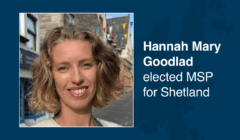
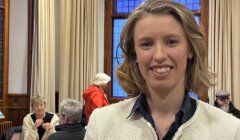
On that note, Erskine said he felt SNP candidate Hannah Mary Goodlad’s slogan about getting a “seat at the table” in an SNP government was “slightly disingenuous”.
He said the SNP have had a “seat at the table” for many years through having a Highlands and Islands MSP – most latterly Emma Roddick – and added that there is no distinction in powers or ability to deliver between regional and constituency MSPs.
Shetland News raised this with SNP leader John Swinney on his visit to Shetland on Monday.
Erskine also said he “completely rejects” the idea from Swinney that his party winning a majority in parliament is a mandate for independence.
“There are people who vote SNP who do not support independence,” he said.
What did else Shetland News learn about Erskine, outside of politics, during our sit-down chat?
Well, the father-of-two is a Ross County fan – “our glory years have sadly dwindled over recent seasons” – as well as a devotee of Scottish rock band Biffy Clyro, who he has reckoned he has seen live more than 20 times.
The song he would recommend to the uninitiated is their track Saturday Superhouse, which opens with the lyrics ‘I’ll be sitting on the left side, you’ll be sitting on the right‘; any political connotations perhaps completely coincidental.
But back to the job at hand. What makes a good MSP? Erskine believes they need to be responsive to the needs of local people, and have a good office to help with the casework – dealing with the concerns of folk in their area.
“I think a lot of MSPs get elected and then spend too much time in the parliament, too much time in the bubble of politics,” he reflected.
“I think being an active local community champion is the right thing to do and be out and about in the community engaging with local people.
“I’m always thinking that the best MSPs are the ones that spend the least time in parliament.”
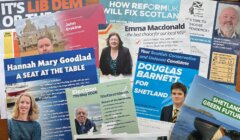
There are seven more candidates contesting the Shetland seat. They are in alphabetical order: Alex Armitage (Greens), Douglas Barnett (Conservatives), Vic Currie (Reform UK), Hannah Mary Goodlad (SNP), Emma Macdonald (Liberal Democrats), Brian Nugent (Alliance to Liberate Scotland) and Peter Tait (independent).
Shetland News intends to run features on each candidate in the run up to the vote on 7 May.
Read our features with Peter Tait and Vic Currie.
Keep Shetland’s news open to everyone
Your membership helps us report the stories that matter to Shetland — and keep them free for everyone to read.