Climate on the agenda at final election hustings
Community benefit from energy and food security were among the key topics

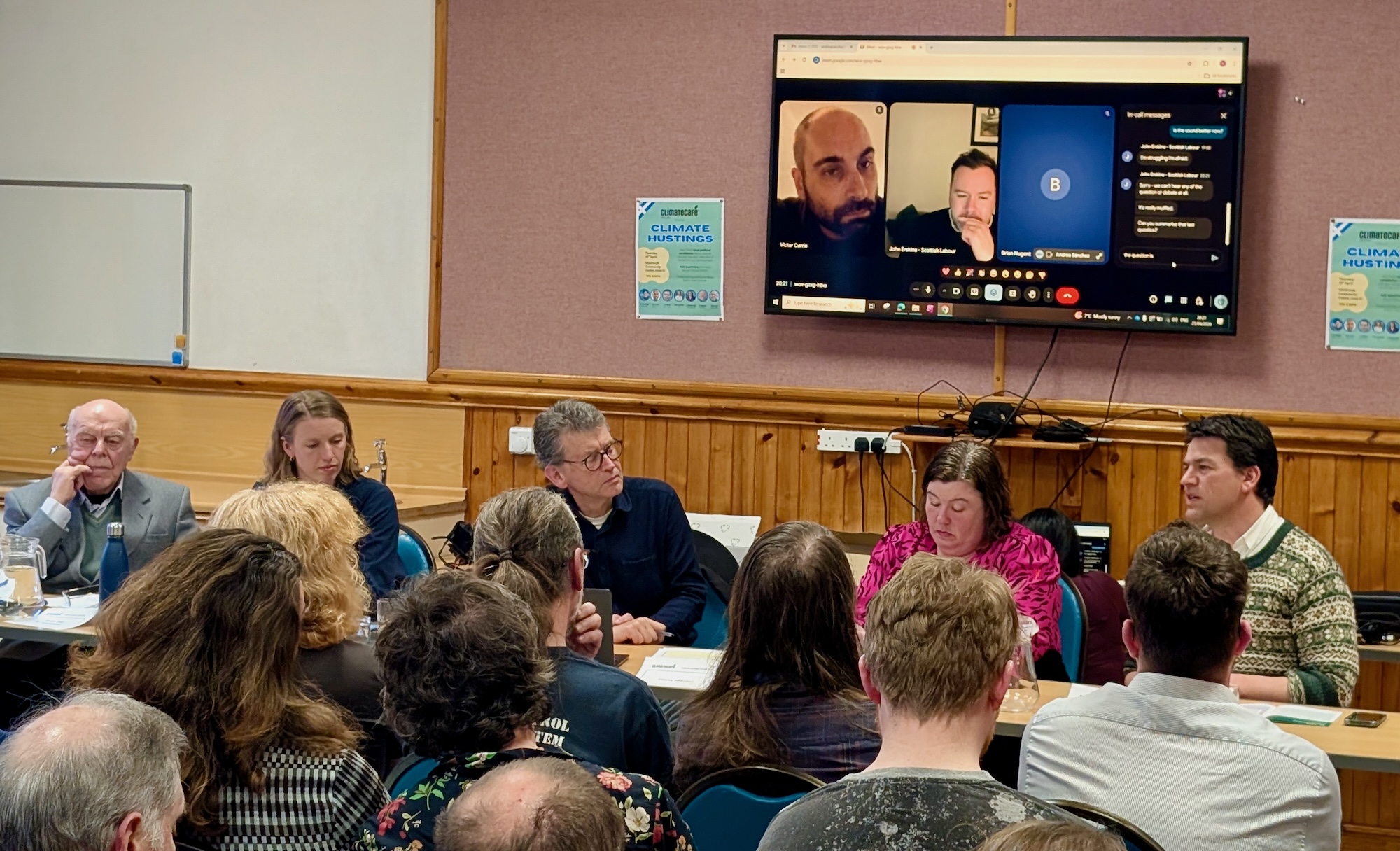
POLITICS can often divide people, but last night’s climate hustings seemed to bring many of the Shetland election candidates together.
There was general consensus on a number of matters, including how there should be greater benefits for communities hosting renewables, and the importance of food security in a place like Shetland.
The lone dissenter was Alliance to Liberate Scotland candidate Brian Nugent, who elicited some groans in the audience when he likened climate change to a “cult” – but more on that later.
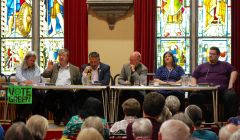
The event was held at Islesburgh in Lerwick by the Shetland Climate Cafe, which holds meetings at which people are encouraged to discuss the topic, in a somewhat ironically balmy Room 12.
It also marked the end of the hustings calendar as the election looms in less than a fortnight’s time.
Moderated by Shetland News’ managing editor Hans Marter, the event opened with organiser Andrea Sanchez Quiroz highlighting to the packed room of around 60 the risk climate change brings to the world – and Shetland too.























She said a key question was how to secure the economy and infrastructure while reducing emissions.
The opening question from Marter gave candidates an opportunity to set out their stall when it came to climate policy.
Scottish Greens’ Alex Armitage said his party stands for two transitions in energy – one from “fossil fuels to renewables”, and one taking power and control from “corporations to communities”.
Reform UK’s Vic Currie, attending remotely, said there is a real risk production and activity is “outpacing our ability to sustain our population, and the natural environment” – adding that his party advocates energy security, such as through domestic oil, and incentivising academic institutions on renewables.
The SNP’s Hannah Mary Goodlad, who has worked in both oil and gas and renewable energy, expressed concern over climate “deniers” – and pointed to her party’s focus on decarbonising as quickly as possible, nature restoration and changes to homes such as insulation and heat pumps.
Help keep Shetland’s news open to everyone

Good local journalism takes time, care and people on the ground. Membership helps us keep reporting the stories that matter to Shetland — and keep them free for everyone to read. Members get a weekly newsletter created especially for them, local ads only, and can bookmark stories and join the conversation in the comments.
A different approach came from Nugent, appearing remotely, who said “I do not believe in net zero” and drew some groans from the audience when he said: “I’m afraid I view climate change as something like a cult”.
Alongside Nugent on the video call screen was Scottish Labour’s John Erskine, who said the SNP governments have not matched the urgency of the climate crisis and added that his party promoted actions in areas such as fuel poverty, community energy and planning.
Emma Macdonald said a key focus of Liberal Democrats was on reducing energy costs, highlighting insulation and heat pumps, but added that there should be “real” community benefit from energy development.
In the absence of any Conservative representatives, the final candidate was Peter Tait – the independent who is standing a ticket to relocate the monarchy to Scotland.
He said despite “massive investment in green energy” the climate problem still grows, and said even if the country achieves net zero by 2045 there may be no noticeable effect globally.
Community benefit from energy development was one topic which drew some consensus from candidates, in terms of people getting a better deal.
Goodlad advocated a move from community benefit to ownership, while Macdonald took aim at the SNP government’s “really disappointing” recent shift in community benefit guidance from £5,000 per megawatt a year to £6,000.
Armitage said “when I hear community benefit I hear community breadcrumbs” and attacked the “corporate control” of energy production.
Currie said it was not right that some Shetlanders were having to choose between “heating and eating” and said Reform supports the long-mooted idea of a “Shetland tariff” – lower bills for local people given the isles’ high energy output.
Erskine highlighted Labour’s GB Energy project, saying it was supporting the move towards more of a community focus, but Goodlad took aim at GB Energy’s progress so far.
She also highlighted options for enabling community involvement such as changes to planning consent and affordable financing options.
Nugent however said it was “a bit poor” that Goodlad made a jibe at GB energy given the SNP had previously proposed a national energy company which never materialised.
When asked for a response to his barb, Goodlad said: “He is entitled to his opinion on that one.”
One topic which drew opposing views was on Shetland Islands Council’s agreement to lease land at Scatsta to Norwegian company Statkraft for the production of ammonia, which was brought up by audience member Adam Priest.
While the council is set to receive more than £1 million a year in rent, and there stands to be around £2 million in community benefit, the deal has been criticised in some quarters as not getting best value.
Macdonald, who is the council leader in her day job, said she was unable to speak about confidential details which were discussed in private meetings.
“There was a process, we followed the process, we were given information and the council made a decision – not just me,” she said.
“We could only operate within the information we had in front of us, and recommendations we were given.”
But Armitage, who is also a councillor, described the deal as a “failure” and called it a “capitulation to corporate power”.
Goodlad, who worked for Norwegian energy giant Equinor prior to the campaign, said politicians need to understand corporations “inside out” and be able to “tackle them head on”.
Elsewhere Transition Turriefield’s Alan Robertson asked about the “pressing issue” of food security, with candidates agreeing that Shetland being self-sufficient was of high importance, particularly when the north boats may be cancelled in winter.
One of the more interesting points came from Robertson himself, who said support usually goes to food producers who export goods.
He said it is “unsustainable to produce food for Shetland consumption”, adding that there is subsidy for lamb and beef but not for vegetable production, which is Transition Turriefield’s area of expertise.
The topic of eco-friendly farming and crofting, and habitat, also got an airing among candidates following a question from Helen Moncrieff.
But discussion was not just reserved to candidates, however, with the audience welcome to have their say too.
One audience member said “energy should not be profit driven”, while another said there needs to be a coordinated plan to reduce emissions.
On the topic of encouraging people to grow their own produce, such as through Goodlad’s proposed ‘grow box’ scheme, one man said the problem is maintaining the momentum.
Another audience member promoted the idea of more education on the topic, which in turn could create greater demand for locally grown produce.
The final question asked candidates what they felt a sustainable and resilient Shetland looks like.
Currie said this is a Shetland that is able to produce as much of its own food as much as possible, particularly fishing, and energy too.
Erskine said “we need to have energy that benefits local communities” in addition to food security – but he said sustainability comes back to the “basics”, like housing, education and health.
Armitage said community organisations should be empowered, highlighting development companies in areas like North Yell, Northmavine and Bigton – and added that human rights was of key importance.
Tait highlighted the importance of being self-sufficient in food and energy, while Goodlad said there is a need for “affordable, reliable sustainable food and energy”.
Macdonald said Shetland needs to be a place where everyone thrives; “we won’t have a sustainable and resilient Shetland if we have half of our community struggling to live well”.
The final word ended up going to climate maverick Nugent, who said the way to “solve all the problems is open up [oil fields] Jackdaw, open up Cambo, open up Rosebank”.
He said the Greens have “no solution to the 6,000 products that oil makes” and added that the party is “taking us back to the stone age”.
Offering a response to Nugent’s jibes, Armitage quipped with a smile in return: “I grease my bicycle chain with vegan bike oil.”
The full list of confirmed Shetland candidates for the election on 7 May, in alphabetical order, are as follows: Alex Armitage (Greens), Douglas Barnett (Conservatives), Vic Currie (Reform UK), John Erskine (Labour), Hannah Mary Goodlad (SNP), Emma Macdonald (Liberal Democrats), Brian Nugent (Alliance to Liberate Scotland), Peter Tait (independent).

Keep Shetland’s news open to everyone
Your membership helps us report the stories that matter to Shetland — and keep them free for everyone to read.