SIC spend on inter-island transport programme soon to reach nearly £2m
The project explores the case for investment in inter-island transport connectivity and is considering the potential for tunnels


SHETLAND Islands Council (SIC) will have spent nearly £2 million on a comprehensive study of its inter-island transport network by the time an outline business case (OBC) comes before elected members next month.
This milestone OBC will allow for comparison between future ferry-based options and possible tunnels for some of Shetland’s islands.
The figure of a near-£2 million spend just to get to the OBC being presented is included in a written submission from the SIC to the UK Parliament’s Scottish Affairs Committee as part of its inquiry into fixed links.
A decision to proceed with tunnels would require around £15 million across 2026/27 and 2027/28 to fund new business cases.
However this could be helped by indications from the Scottish Government that a total of £26 million in capital funding is destined to come the SIC’s way for inter-island connectivity over the next four years.
The SIC also wrote to the Scottish Affairs committee that fixed links have the “potential to transform Shetland’s whole economy” while increasing the sustainability of islands.
So far the inter-island transport study – led by consultants Stantec – has produced a strategic outline case, which was approved by councillors last year and saw tunnels to Yell, Unst, Whalsay and Bressay taken forward for further consideration.
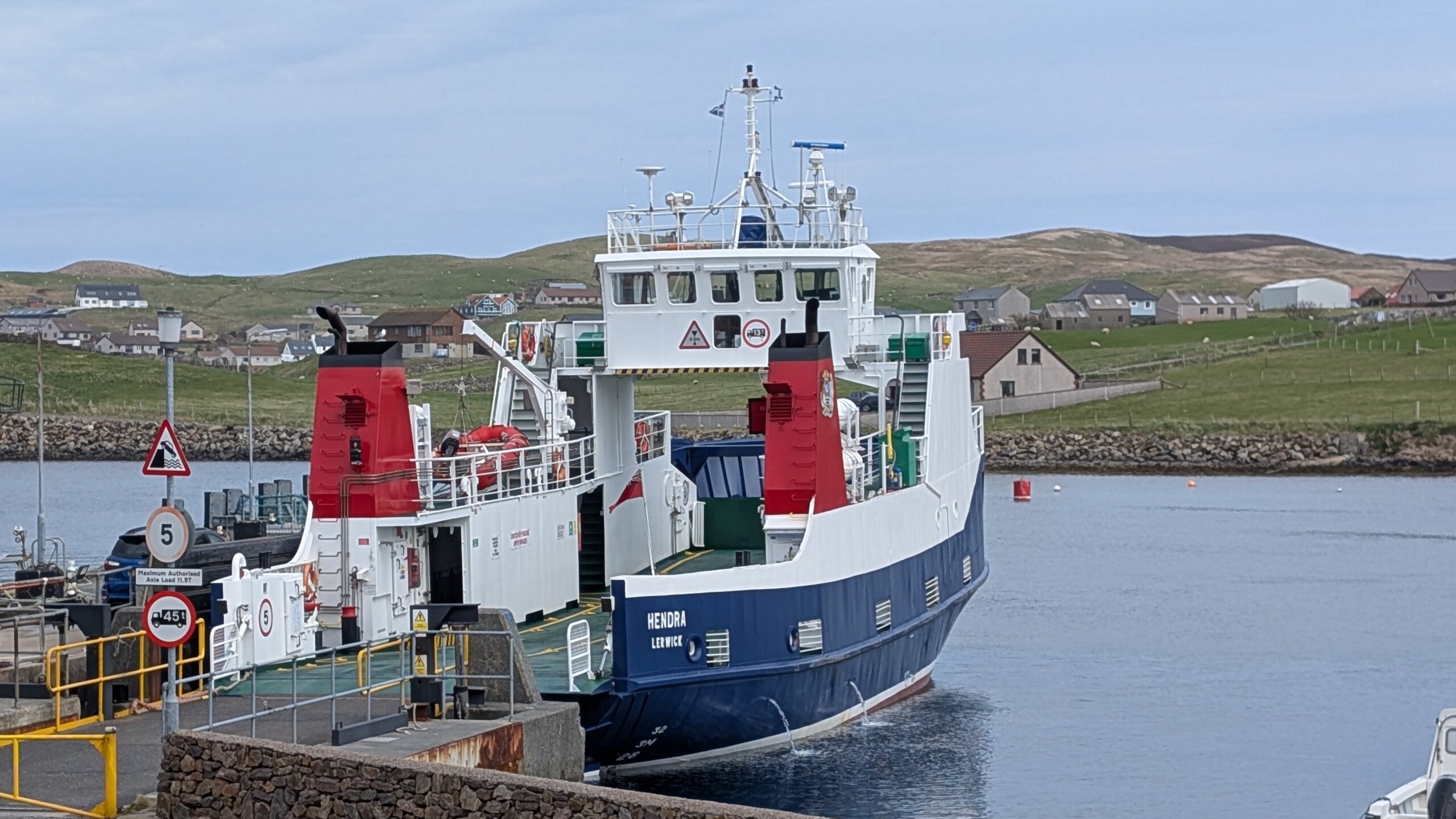
The submission to the Scottish Affairs committee highlights that the average age of an SIC ferry is 31.5 years, and that the fleet is “increasingly facing reliability, capacity and accessibility challenges”.
It adds that the running costs of the SIC ferry service have risen from £15 million in 2015/16 to £25 million, with the deficit now being met by the Scottish Government as part of a funding scheme put in place a number of years ago.
It also highlights population retention as the “major challenge” faced by Shetland’s island communities, while it also points to the disruption faced by island businesses when there are issues with ferries.
Help keep Shetland’s news open to everyone

Good local journalism takes time, care and people on the ground. Membership helps us keep reporting the stories that matter to Shetland — and keep them free for everyone to read. Members get a weekly newsletter created especially for them, local ads only, and can bookmark stories and join the conversation in the comments.
The SIC added that any potential downsides to fixed links would be “fully explored” in the OBC, while it also pointed to upcoming community drop-in sessions across the islands.
The council has also embarked on a ‘fixed link model’ (FLM) study to better understand how tunnels could be delivered in Shetland, with the written submission calling this a “groundbreaking” project which engages with contractors and external financiers.
This is using Yell Sound as a “test case”, and it is considered essential for “parity of appraisal” between ferries and tunnels in the OBC stage.
The SIC was also asked what role the UK Government could play in supporting fixed-link infrastructure, given that transport is devolved to Scotland.
In response, it said Shetland is home to some nationally important infrastructure and industries, including the SaxaVord Spaceport.
“Shetland’s key industries – energy, space, fisheries and aquaculture – cannot achieve their full potential without a substantial improvement in the islands’ infrastructure,” the council added.
“Transport improvements now will enable those industries to fulfil their potential, not only for the benefit of Shetland but for Scotland and the UK. Sharing the costs of fixed link developments would therefore be supportive of the aspirations of Shetland and the country as a whole.”
This support, the council said, could come in a number of ways, including the UK Government exploring with the local authority opportunities for low-interest loans or guarantees for private finance.
“The UK Government could explore how it could give confidence to any project in other ways, including to other funders, and explore how it could work with the Scottish Government to support projects of mutual interest, in a similar way to how support has been provided to the city and region growth deals, including the Islands Growth Deal,” the council added.
“Another consideration for the UK Government may be exploring ways to potentially incentivise pension funds to invest in specific infrastructure assets.
“It should be noted that the council is already having initial conversations with various bodies, something that will be explored further through the FLM study.”
It highlighted how the UK Government has previously announced funding for developing improvements to the A75 road, which connects to the Stranraer ferry port on Scotland’s West Coast. The UK Government has also provided funding for a new Fair Isle ferry, which is currently under construction.
The SIC further said the studies in Shetland are “inspired by the socio-economic successes seen in the Faroe Islands” through its network of tunnels.
“The Faroese projects have been financed through both government funding and Public-Private Partnership (PPP) models – both approaches that the FLM will also explore,” the council added.
Another response to the Scottish Affairs committee has come in from Shetland’s regional transport partnership, ZetTrans.
Its response said it did not wish to pre-empt any conclusions of the OBC, instead offering a “strategic” look at the topic of fixed links.
ZetTrans pointed out that even if Shetland had a fully renewed ferry fleet, challenges with crewing the vessels would still remain – highlighting an ageing workforce as well as competition from other sectors such as aquaculture.
When it comes to the environment, ZetTrans said decarbonising ferries is possible but “expensive, technically demanding, and dependent on future technology maturity” – therefore fixed links offer a different way to reduce emissions.
Its submission adds that the “detail of engineering and design solutions that are proportionate to Shetland circumstances (relatively low traffic volumes) and geotechnical conditions are areas of current uncertainty”.
ZetTrans also sought to highlight the risk of inaction. “The committee may also wish to note the risks associated with non-decision or prolonged uncertainty,” it added.
“Without long-term clarity on the future of the inter-island network, public finances remain exposed to recurring vessel and harbour replacement cycles, workforce pressures compound, recruitment in essential public services becomes more difficult, and demographic decline accelerates.”
International engineering consultancy COWI, which is working on the SIC’s fixed link model project and contributed to the inter-island strategic outline case, also responded to the inquiry with a written submission.
It concluded that the “challenge lies not in engineering or construction capability, but in political vision and ambition, supported by sustainable financing and decisive central government backing”.
COWI said it has worked in Shetland for more than 20 years, and has also supported a “range of Nordic subsea and rock-tunnelling projects”.
It explained that the FLM does not concern itself with technical or engineering feasibility, “but rather on the mechanisms of procurement, organisational structure and financing to deliver the link”.
“This is the most detailed work ever undertaken on tunnels in Scotland, and will not just inform Shetland’s tunnelling options but those of island communities across the country,” COWI’s submission said.
“We are clear that from an engineering perspective creating fixed tunnel links between our islands and Scotland is technically feasible and we have the civil and mechanical engineering skills, and experience, to design and construct the tunnels.”
COWI also said that central government “should be taking a keen interest in fixed link infrastructure, both because of the role it can play in the social regeneration of its remote and rural areas, but also because of the economic advantages it can unlock”.
Writing to the committee in December, former Scottish transport secretary Fiona Hyslop said the Scottish Government “fully recognises the benefits that a fixed link can bring to island and rural communities”.
She highlighted the financial support the SIC receives from the Scottish Government for running its ferries, as well as a one-off £10 million grant for inter-island connectivity, which the council is planning to use on a new relief ferry.
Hyslop highlighted the UK Government’s near £27 million funding for a new Fair Isle ferry, but said although the funding was welcome it “needs to be set in context of the overall need and the significant annual funding already provided to local authorities to support the running of services”.
The SIC is also set to provide nearly £19 million itself to the project, which also includes harbour upgrades in Fair Isle and Grutness in Shetland’s South Mainland.
Meanwhile MPs on the Scottish Affairs Committee took a trip to Faroe in March as part of its inquiry.
They spoke with tunnel operators, the local community, arms-length bodies, telecommunications companies and economists about the impact of the Faroes’ digital and transport infrastructure.
The MPs also visited the Scottish island of Skye, where a bridge was constructed in 1995.
In addition to this the committee has held a “roundtable” meeting with other MPs in private, touching on fixed links and digital connectivity.
Notes from this meeting included that members noted how the “case for fixed link connectivity is not uniform across the Scottish isles – in particular, it was felt that fixed links may be more feasible in the Shetland Islands, compared to the Western Isles, on account of the higher levels of economic activity in the former”.
Meanwhile oral evidence is set to be taken by the committee on Wednesday 20 May.
Among those speaking will be SIC depute leader Gary Robinson and COWI’s UK managing director Andy Sloan.
Keep Shetland’s news open to everyone
Your membership helps us report the stories that matter to Shetland — and keep them free for everyone to read.