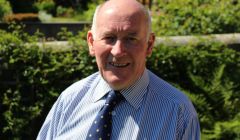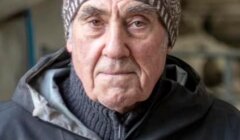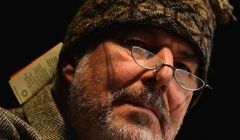

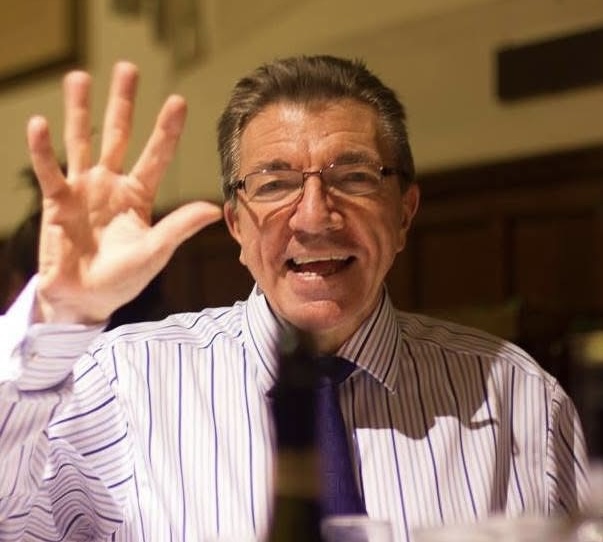
Dr George Colin Stove (1949-2026): ‘an inventor in the truest sense’

Born into a croft in Sandwick, Shetland, in 1949, Colin has always remained proud of his island heritage and childhood upbringing throughout his life.
He would often share many stories of his early years in Sandwick, often regaling adventures involving lobster catching as an entrepreneurial endeavour, scientific capers involving chemical experiments and raising many cats.
His love of sailing in Shetland inspired him to apply to serve his country in the Royal Navy, however his eye sight prevented his successful application. It was then that he turned his sights to the mainland and enrolled to study geography at the University of Aberdeen, where he achieved his BSc with honours in 1972 and his PhD in geography and geology in 1978.
It was at Aberdeen that Colin came under the tutelage of Professor R. V. Jones — Winston Churchill’s chief scientific intelligence adviser during the Second World War, the man who outwitted German radar in the ‘Battle of the Beams’, and the holder of Aberdeen’s Chair of Natural Philosophy.




















Jones ignited Colin’s scientific curiosity and started him on the journey into radar research that would shape the rest of his life – a lineage running from one of Britain’s great radar minds to a career spent pushing radar further than anyone believed possible.
During his time at Aberdeen University he also met his wife Helen at the ‘Woodchuckers Ball’ at the Beach Ballroom. Their dancing that night saw the beginning of an everlasting love and a 58-year journey as soulmates.
They married in 1970 and had their first child Melvin in 1974, shortly followed by their second son Gordon in 1976 and then their daughter Pauline in 1978. It was during these years when Colin committed his priorities as family man first whilst balancing his career as a remote sensing scientist pioneer.
Help keep Shetland’s news open to everyone

Good local journalism takes time, care and people on the ground. Membership helps us keep reporting the stories that matter to Shetland — and keep them free for everyone to read. Members get a weekly newsletter created especially for them, local ads only, and can bookmark stories and join the conversation in the comments.
His initial employment placed him at the frontier of remote sensing. At the Macaulay Institute for Soil Research, where he rose to principal scientific officer and led its remote sensing unit, he pioneered the use of LANDSAT satellite data, aerial photogrammetry, and radar to map Scotland’s peatlands and terrain — work that drew international recognition and saw him appointed twice as a principal investigator to the European Space Agency in the early 1980s. It also afforded multiple excursions to solve problems in North America and the Middle East.
In 1983 he was headhunted to lead radar technology research for a company serving UK Government and defence, as scientific director and chairman of the board. Helen jumped at the opportunity to explore life outside Aberdeen and move to Edinburgh, where they also soon settled into the social circles of Bruntsfield and Morningside and a more cosmopolitan Scottish city.
In 1988 he founded Geospace Consultancy Services Ltd, pioneering precision ground penetrating radar for non-destructive inspection. Following the sale of that business in 1994, he established his own consultancy and, with the freedom to pursue the idea that would define his geophysical legacy, began developing atomic dielectric resonance — an achievement realised across three breakthroughs in 1982, 1992, and 1997. He patented the invention and co-founded Adrok, with his son Gordon, to commercialise it.
Colin was always very proud of his family involvement in and ownership of the company. Throughout his career as an inventor and experimenter, he became one of the most original remote sensing scientific minds Scotland has produced.
Colin was the founding inventor of atomic dielectric resonance (ADR), and his genius reshaped how we see beneath the surface of the Earth — and, latterly, within the human body.
Colin was an inventor in the truest sense. A gifted experimenter and hardware developer, he possessed a rare command of remote sensing, mapping, imaging, and signal processing, and an even rarer ability to fuse them into something entirely new.
Named inventor on three patents for his ADR inventions, he was the first person in the world to discover how to generate deep-penetrating radiowave signals that could travel several kilometres through solid ground — and then to apply spectroscopic techniques to those returning signals to classify the composition of the material below.
Where conventional radar could only glimpse the shallow subsurface, Colin found a way to see kilometres down, and to identify what he was seeing. It was a scientific first with few parallels, and it remains the foundation of everything the company does today.
The breadth of ADR’s application reflects the breadth of Colin’s own imagination. The technology has been used in the exploration of oil, gas, minerals, and geothermal resources, and in archaeological investigation.
Most strikingly of all, Colin turned his invention toward medicine — achieving genuine breakthroughs in the scanning of blood samples, and pursuing trials in cancer detection and disease diagnostics in collaboration with clinicians and institutions including the Scottish National Blood Transfusion Service and the University of Edinburgh.
He never stopped believing that a technology born to look into rock could one day help to heal.
For all his empiricism, Colin was as much an artist as a scientist — and he saw no contradiction in that. A practical experimenter who loved, above everything, to take measurements, he was also creative, musical, and a firm believer that the worlds of science and art intersect and intertwine. He brought an artist’s eye to the processing of his images and the interpretation of his data, trusting that creative intuition and rigorous measurement were partners rather than rivals. It was often that artistry, as much as the mathematics, that allowed him to see meaning where others saw only noise.
Colin’s contributions were widely honoured. He served as vice chairman of the Association of Consulting Scientists and as a trustee of the Soutra Archaeo-Medicine Trust, and in September 2021 he was bestowed, by invitation, the honorary fellowship of the Royal Scottish Geographical Society. Though he stepped back from his executive role in 2026, he continued to advise and inspire the company he built until the very end.
Those who knew Colin will remember him as much for his spirit as for his science. He had a remarkable knack for inspiring the people he worked with, and he delighted in talking about his experiments with anyone and everyone who would listen.
As so many who met him would say: “I didn’t understand half of what he was talking about, but I was spellbound by his passion, his enthusiasm, and his love for what he was saying.” He approached his work with joy, and his energy was infectious — the kind that lifted a room and made the hardest problems feel worth chasing.
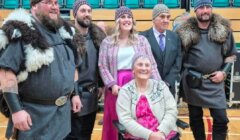
Throughout his life in Aberdeen and Edinburgh, Colin remained dedicated to his Shetland roots and culture. He was a regular attendant at Shetland Society meetings and events and regularly participated and helped organise Up Helly Aa events. He always loved sharing his Shetland heritage with his family and friends.
Colin is survived by his wife, three aforementioned children and five grandchildren Jackson, Hayden, Abbie, Sam and Ruby.
He leaves behind not only a body of work, but a way of working — inventive, artistic, fearless, and joyful. His genius made the impossible look inevitable, and his technology continues in the hands of those he taught. He will be forever remembered for his big heart, boundless energy and cheerful disposition.
Dr George Colin Stove – 13 July 1949 – 20 July 2026
Submitted by the Stove family
Keep Shetland’s news open to everyone
Your membership helps us report the stories that matter to Shetland — and keep them free for everyone to read.