


An islander’s mindset at the heart of government
Three months after Shetland winning a seat at the government table, newly elected MSP Hannah Mary Goodlad finds space in her busy schedule to sit down and reflect about life, politics and what’s in it for Shetland

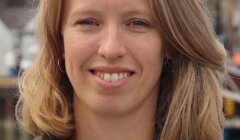
“BEST job ever” is how Hannah Mary Goodlad sums up her double role as Shetland’s new MSP and the Scottish Government’s minister for public finance.
It’s just about 100 days since she was elected as the isles’ first ever SNP representative, and it is fair to say that she has taken on the role with an energy and public presence rarely seen before.
It is obvious that, coming from an executive role in the energy industry, she thrives on high-powered, high-energy jobs, which in this case is further fuelled by the huge mandate she received in the May election.
So, a little over three months after that landslide victory and the widely expected call into government, how is she coping with the demands?
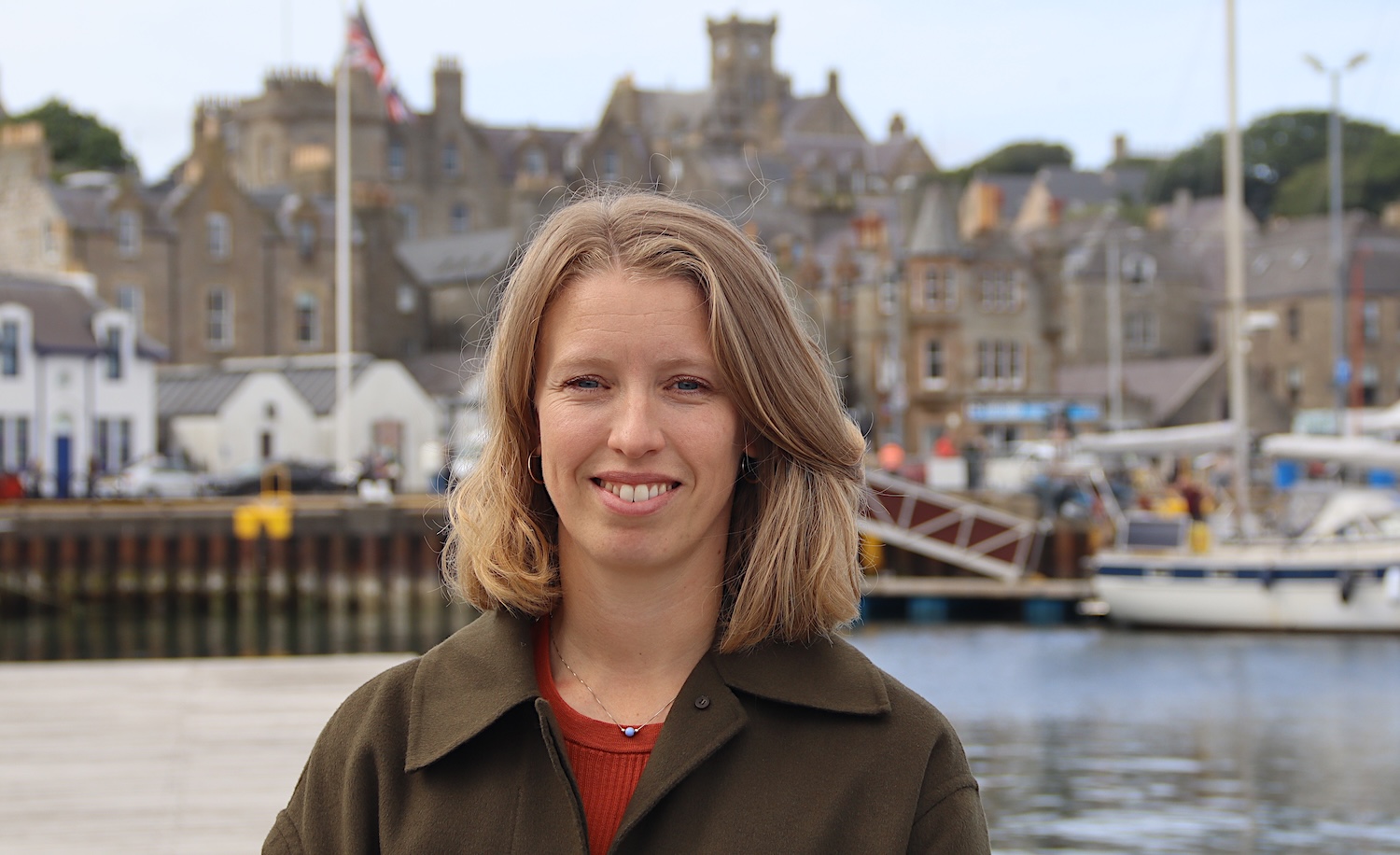





















As we settle down for a longer chat at a sunny and very busy Lerwick waterfront, she freely admits that she has embarked on a huge learning curve empowered by the privilege of giving a voice to her home community.
She sees her role as “making sure Shetland is in the discussion [at government level] every single day”.
“If we get this right,” Goodlad says, “Shetland will be a better place in the next five years.”
That’s a bold statement to make and no doubt local people will watch closely at how, and if, Shetland will change over coming years, but the freshness and the belief that politics and politicians can actually change society certainly has an appealing attraction.
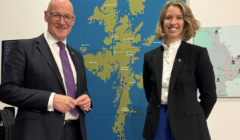
She says she would have liked a little more time to find her way around parliament and settle into her new job, but when first minister John Swinney called a few days after being elected to offer her the heavy public finance brief, she says she was ready to accept.
Help keep Shetland’s news open to everyone

Good local journalism takes time, care and people on the ground. Membership helps us keep reporting the stories that matter to Shetland — and keep them free for everyone to read. Members get a weekly newsletter created especially for them, local ads only, and can bookmark stories and join the conversation in the comments.
“I know that the first minister needs my private sector experience at the heart of government; an ability to think in different ways, an ability to challenge the status quo,” Goodlad says.
Another bold statement, and there are more to come.
That public finance portfolio, described by her as “the backbone of government”, includes not just the job of balancing the books at a time when the government’s own medium-term forecast predicts a £5 billion funding gap by 2029/30.
Her brief also includes planning, community wealth and empowerment, and requires her to be at the centre of the discussions on public service reform – a government flagship policy for the next five years.
No one knows how this is going to pan out, and there will likely be some heavy resistance from within Scotland’s large public sector, but the ambition is, in Goodlad’s own words, to “rewire the state” and to create a more “preventative, more joined-up system” that takes care of the most vulnerable and works for all in society.
“This is going to take several years to implement. We want to redesign the system, and that is about looking at everything across the board.
“It’s about looking at local government. It’s about looking at the NHS. It’s about looking at our public bodies, of which I think there are 132 across Scotland. So, when you rewire the state, everything is on the table.”
“This is going to be done with delivery partners and be done with COSLA and local authorities, because they’re our partners in delivering a lot of these public services, but I’m very clear that the way that we reform the state has to go hand in glove with how we look at local government.
“I made no secret in the [election] campaign that I know autonomy works. I know devolution works.
“The devolution drum is being beaten right now from Number 10 North in Manchester and in Number 10 slightly further south in in London. But an extended mayoral system here in Scotland is not what we need.
“We need to be looking at a homegrown system of local governance that might not look like it does today. (…) But that’s not going to be done locking ourselves away in a room in Edinburgh and deciding that.
“And that’s why government and government ministers are using the summer recess to get out there and talk to delivery partners and communities.”
Failing the public purse
And while in the process of rewiring the state, funding aviation across the region will undoubtedly come up in these discussions.
Although she doesn’t say so explicitly, it is clear she and others in government are not happy with the way the recent discussions with government-owned Highlands and Islands Airports Ltd (HIAL) and Loganair concluded.
The Inverness links were saved for the moment at the cost of an extra £1 million, only for Loganair to announce the closure of its Dundee base a few days later.
Transport minister Stephen Flynn has said he wants to see more delivered for the almost £70 million of public money that is spent on HIAL and the air discount scheme (ADS).
Goodlad, when asked, concedes that one million is a lot of public money, and adds that aviation in the Highlands and Islands, where it is part of public transport, needs a holistic solution “because this piecemeal approach is failing communities, and it’s failing the public purse.”
Going back to community empowerment, which is part of her extensive brief, the forthcoming community council convention on energy development 22 August will be all about that, and the expectations on Goodlad are tangible.
She will also co-hosting with MP Alistair Carmichael a series of tunnel vision meetings in the coming days.
But as a government minister she has two roles, which at times are mutually exclusive.
‘Putting police before party’
She is clear that, yes, she will be attending these meetings, but as Shetland MSP and not as the Scottish Government minister for public finance.
“These big meetings are important for me to attend because it’s our community and I want to be there and be present, be seen and be heard, but I’m not there as the finance minister and [to] make promises.”
She adds: “It’s really important to explain that the last time Shetland had this opportunity with an MSP being a government minister was when Tavish [Scott, who was transport minister from 2005 to 2007].
“Being a minister is a real opportunity and upside for the constituency, because it means that the island perspective that I’m bringing is at the heart of government policy and government decisions.”
However, as said before, she cannot make decisions, financial or otherwise, solely for her constituency, that would be undemocratic.
“It’s right and fair and proper that these checks and balances exist, and Shetland, my community, our community, needs to appreciate and understand that delineation.
“Our predecessors as MSPs did not take decisions for Shetland, and I think that’s a piece of information that’s missing from the public discussion.”
She says she agrees with her friend and colleague Stephen Gethins who, as energy minister last month expressed his sympathy for the communities wanting to have a greater say in large energy development – of which there are an ever-growing number in the islands.
But how could that realistically be achieved when most of the decision-making powers are reserved to Westminster?
She highlights an ongoing consultation on whether to give local planning authorities the power to decide energy projects above 50MW, and points towards a proposed Shetland Energy Act, one of the key planks of her own local election manifesto.
If enacted, this would move from communities receiving benefits to communities becoming part-owners in these developments and thereby creating wealth that as equity stays in communities.
And since most policies around energy is reserved to Westminster, she is looking to work cross-party and hopes that MP Alistair Carmichael will join her at that table.
“The real challenge right now are energy bills,” she says. “We host one of the largest onshore wind farms in the whole of Europe, and we have the highest fuel poverty here.
“So, I am looking to Alistair [Carmichael] to work alongside me, put the place before the party, and get things done for Shetland, and improve lives here.”
Hannah Mary Goodlad also to spoke to journalism student Maddison Reynolds on government policies for young people and on the use of social media as a communication tool. This second interview will be published tomorrow (Tuesday).
Keep Shetland’s news open to everyone
Your membership helps us report the stories that matter to Shetland — and keep them free for everyone to read.