

Viewpoint / Both votes SNP will harm independence movement
Jago Gibson is a Shetlander who moved back to the isles last year. He was very active in political organising and activism during his time down south, and has a keen interest in the upcoming Scottish parliament elections

Last week an article was published talking how the best way to counter Reform gaining seats in the Scottish Parliament was to vote Greens in the lists.
To put it plainly this is correct – if you want to prevent Reform gaining their projected seats in the regional vote, you should switch your vote to a different party that won’t win as many constituencies in the Highland and Islands region.

If you want to stop Reform AND increase the amount of pro-independence MSPs then the only real option is to vote Greens in the list.
It was disheartening to see so many comments not take any of this on board and state they would still be voting SNP on the lists, so let me try explaining the reasoning why you shouldn’t.
And let me preface with this, I am not and have never been a Green party member. I used to be an SNP member and left the party in 2022. I simply want to see Reform gain as few seats as possible and have the best parliamentary outcome for independence in this election.

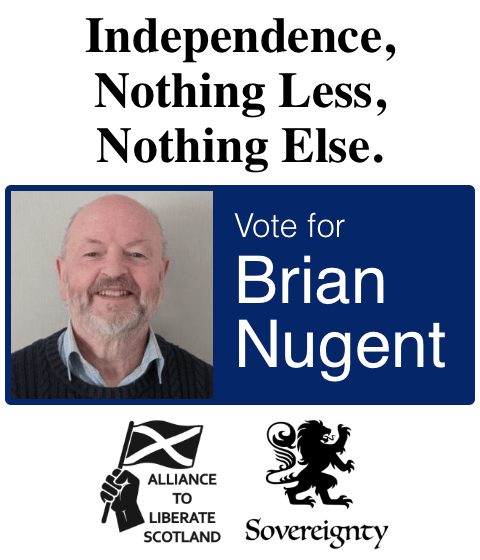
My overall message to you if you are one of the many people that want to curb Reform’s rise and increase the amount of pro-independence voices in the Scottish Parliament, do not vote SNP in the lists. The two points I raise are: your vote is worth less, and it harms the independence movements representation in parliament.
First, mathematically why your SNP list vote is worth less.
As you know the Scottish Parliament operates an Additional Member System – it has 129 seats, 73 of those being constituency, and 56 regional.
This structure exists to prevent one party dominance and secure proportional representation.
This is done by adhering to the D’Hondt method, and this lasts seven rounds. It works by first dividing a party’s regional vote by the number of constituency seats + 1 it has in the region, and then in subsequent rounds, by the number of constituency + regional list seats + 1 a party has. (The plus one is applied to all parties so there are no mathematic impossibilities so can be treated as if it weren’t there.) Basically, the more seats you already have, the less your vote counts.

















What does that mean for us? Well, we need to remember that we are in Scotland and not an isolated island nation, and part of the wider Highlands and Islands region. The most recent polling average puts SNP on track to win five constituency seats out of eight. (Six if Hannah Mary can finally flip Shetland!)
So, before the first list seat is even declared, your SNP list vote could be worth one sixth of a vote compared to Reform or the Greens.
Let’s look at the current polling averages for the list vote in the Highlands and Islands.
The SNP are projected to comfortably lead the list vote, with the numbers at.
SNP: 29%
Lib Dems: 18.1%
Reform: 17.7%
Conservatives: 12.6%
Greens: 11.1%
Labour: 8.1%
And where does this leave us on the amount of regional MSPs?
SNP: 0
Lib Dems: 0
Reform: 3
Conservatives: 2
Greens: 1
Labour: 1
So what happened here? This discrepancy exists because as current projections go, SNP and Lib Dems are going to win constituency seats, lessening their regional vote.
Just for better understanding and visualisation, here’s a few different scenarios, all using the current average polling estimates. One where all the Green voters choose SNP, one where all SNP voters choose Green, and one which is the bare minimum of SNP voters to Greens that prevent Reform winning a third seat.
Scenario 1: The SNP scenario, all Green regional votes go to the SNP, the final regional seat count goes:
SNP: 1
Lib Dems: 0
Reform: 3
Conservatives: 2
Greens: 0
Labour: 1
We see a switch, SNP win one seat in round five, rather than the Greens currently projected to win one in the third round. This is a like-for-like pro-independence MSP switch, not doing anything to further increase the amount of pro-independence MSPs in the Scottish Parliament. And notably, Reform still gain three regional MSPs, regardless of if SNP have the entire 40.1% vote that pro-indy parties are projected to get.
Scenario 2: The Greens scenario, all SNP regional votes go to the Greens, the final regional seat count goes:
SNP: 0
Lib Dems: 0
Reform: 2
Conservatives: 1
Greens: 4
Labour: 0
A large difference due to Greens not being held back by the projected five seats SNP are getting in the constituencies. Greens would win four seats, taking away a seat each from three unionist parties, Reform, Conservatives and Labour, clearly maximising the independence bloc in the Scottish Parliament.
And while this obviously isn’t realistic, but let’s try one more scenario, one where, using these same projections, but there is just a 1% swing, from SNP to Greens in the regional list vote.
Scenario 3: The bare minimum scenario. In this scenario we would have just a 1% change from SNP to Greens, so the total regional vote share would look like this:
SNP: 28%
Lib Dems: 18.1%
Reform: 17.7%
Conservatives: 12.6%
Greens: 12.1%
Labour: 8.1%
And the final regional seat count from this scenario?
SNP: 0
Lib Dems: 0
Reform: 2
Conservatives: 2
Greens: 2
Labour: 1
This is a 1% total switch, or roughly just over 3% of the projected SNP regional list voters in Highland and Islands to switch over to Greens. This would mean that the Greens win their second MSP in the final round, and this would prevent Reform gaining a third seat and add one more pro-independence MSP to parliament. In the scenario where the SNP gets every single Green vote, that keeps the amount of pro-independence MSPs the same.
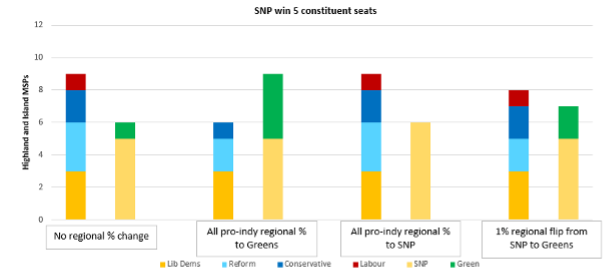
Now keep in mind these scenarios are based on polling that SNP gain five Highlands and Islands seats and Liberal Democrats three.
I’m sure some are ready to counter with the reasoning that SNP might not win all these seats, so let’s very quickly look at some outcomes based on constituency seats won, with the same aggregated regional polls, simplifying it down to pro-indy and unionist seat totals.
4 seats: If SNP only win 4 seats and maintain their 29%, they still win 0 regional seats, and the total for Highlands and Islands regional and constituent seats are, 5 pro-indy, 10 unionist. Regional seat holders are unchanged.
If SNP win 4 seats AND Green get the 1% swing we talked about before? 6 pro-indy, 9 unionist, again taking a unionist seat away from Reform specifically.
If SNP win 4 seats AND Green get the full independence vote? 8 pro-indy, 7 unionist. Back to a majority pro-independence. This is the only outcome where pro-indy have a majority in Highlands and Islands, if reversed and SNP get the full pro-independence vote it ends up being 6 pro-indy, 9 unionist, the SAME outcome if just a 1% swing went to the Greens.
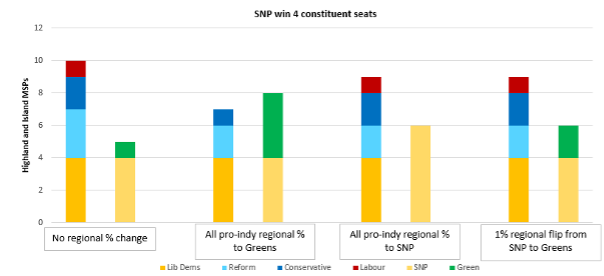
3 seats: Now here we finally go, if SNP only win 3 seats in Highlands and Islands then with their 29% they win 1 regional seat, totalling again, 5 pro-indy seats and 10 unionist.
And here’s the numbers for different swings. If Greens got the entire independence vote, 7 pro-indy, 8 unionist, the best outcome for parliamentary independence here. If the SNP get the full independence vote, 6 pro-indy seats, 9 unionist. But this same outcome here can be achieved now by an 8% swing from SNP to the Greens, (27.59% of SNP voters to switch) in this scenario where SNP only win 3 constituency seats in Highlands and Islands.
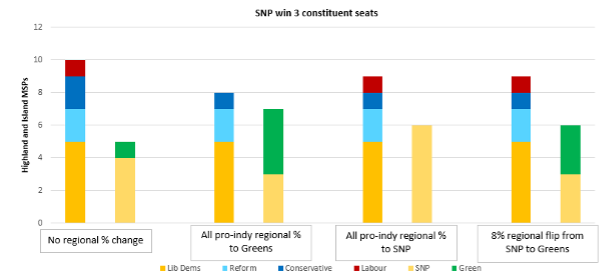
To use pro-independence votes most effectively to maximise pro-indy seats, based on current polling, do not vote for SNP in the lists.
Secondly, this push for both votes SNP harms the independence movements representation in parliament.
Because the SNP is already so dominant in constituency seats, does hoarding regional votes do anything to achieve the maximum amount of pro-indy MSPs in the Scottish Parliament? Or does it actually limit the size of the independence bloc?
SNP are polling at 63 seats now, and while it is correct a couple more would guarantee an SNP majority, trying to overturn a system that is designed to prevent a one-party majority by forcing through a couple list MSPs is essentially wasting independence votes that could be used elsewhere.
This isn’t a strategic vote, this is an emotional one, one that could have backlashes for the independence movement.
For the success of the independence movement, we cannot allow it to be tied to one party. We’ve seen the collapse of the Conservatives and Labour in the polls, and we would be naive to assume the SNP is immune to this. If we restrict any alternative pro-indy voices, who will be left to keep independence alive in the Scottish Parliament if SNP suffer a similar fate?
We need to build a strong coalition of pro-independence voices in parliament, to ensure the growth and survival of the movement in parliament.
If you are an SNP list voter and are using independence as a bargaining tool to get others to use both votes SNP, you are actively damaging the cause, and those that are voting for pro-independence opposition voters are doing more to increase representation than you.
I also notice it is the same people who are saying in one breath that you must use both votes SNP now, and after independence you can vote for whoever.
This is a major contradiction, divergent opinions are unacceptable now, but encouraged later? All this narrative exists to do is reduce any competition in the independence movement, concentrating the movement into one party, and frame non-SNP pro-indy parties as threats.
If you are voting SNP both because you truly think they are the best party to run the country and want them to have an outright majority and independence isn’t a pressing issue, then I can see why you would stick with SNP. But don’t pretend you’re doing more for independence than those actually trying to build the maximum pro-independence majority.
Even then, your list vote would be better used on a party that’s more sympathetic to SNP domestic policies that won’t dominate constituencies as the SNP does.
Overall, it needs to be remembered, the D’Hondt method is an immutable fact of the Scottish Parliament, taglines and emotive language will not change this.
It realistically does not matter how many list votes the SNP gets, they will not see nearly as much benefit from them as the Greens would.
Do we want to centralise power in the SNP, risking the independence movement’s or increase pro-indy representation?
So if you want the independence bloc to be at its strongest in May, and to prevent Reform winning a projected 3 seats in the Highlands and Islands, vote Green in the lists.