



The progressive economic link Scotland should be aiming for
In this Viewpoint piece the Shetland Fishermen’s Association argues that the Scottish Government’s landing target policy for pelagic vessels should be redesigned to ‘reward genuine economic value’


The Scottish Government claims that its landing target policy is about maximising the economic benefit of Scotland’s national fishing resource.
But, in Shetland, it’s achieving the opposite, weakening the agency of local fishermen, while directing more of the value towards shoreside interests, including businesses whose owners and profits are not based here.
The quotas and vessels involved in Shetland’s pelagic fishery did not simply fall out of the sky and into the laps of a fortunate few. That fishing opportunity represents many decades – in most cases, generations – of investment, risk and hard work. They are the product of families putting their homes, businesses and livelihoods on the line to buy boats, fish through difficult years and build efficient businesses in one of the most demanding industries imaginable.
The Scottish Government’s current policy requires that those pelagic vessels land at least 70 per cent of their mackerel and herring catches into Scotland. The Government says the purpose is straightforward: to secure greater economic benefit from Scottish fish for Scottish processors, ports and communities.


























That is an entirely legitimate objective, worthy of support. The question is whether the current policy actually achieves it.
For more than a century, Shetland fishermen have organised themselves precisely because they understood that catching fish was only half of the battle. The other half is having the ability to sell it.
For generations before they had meaningful commercial independence, Shetland’s fishermen operated within systems in which lairds and merchants exercised grasping control. The historical record of the haaf fishery describes fishermen working with boats and gear owned by their landlords, with catches sold through systems that left tenant fishermen with little bargaining power. The old truck system could mean that fishermen were paid in credit redeemable only through their own landlord’s shop.
The Shetland Fishermen’s Association has existed in one form or another for more than 100 years. Much of the history of Shetland fishing over the last century can be understood as the gradual movement of key decisions away from landlords, merchants and other shoreside interests and towards the fishermen themselves – creating auction systems and markets which gave fishermen more control over their catch, and the reward received for their labour, investment and risk.
This is not a story about fishermen being handed an economic asset.
It is a story about fishermen collectively changing the old balance of power, striving for fairness and agency and progress.
The Scottish Government’s landing target is regressive in that regard, a policy that threatens to turn the clock back to a time when Shetland fishing crews were forced to take the price that they were given, and the profit from their own labour was not theirs to keep.
There is nothing inherently wrong with wanting more fish landed into Scotland. Scottish processors need raw material. Ports need activity. Jobs matter.
But, in Shetland, we might rightly look around at our main industries and wonder what has gone wrong. Across oil and gas, aquaculture, renewable energy and, yes, fish processing there is relatively little local ownership – it has been replaced by foreign investment. That investment, perhaps, has been a necessity – the only viable way of keeping the economic activity and associated jobs in the isles – but the undisputable consequence is that much of the profit generated by those industries ultimately leaves Shetland.
A lot is being done in Shetland, and done to Shetland, but how much of it is done for Shetland?
Our fishing fleet is different. It is still substantially owned by Shetlanders. The profits from its catches stay in Shetland; supporting local families, paying taxes, buying goods and services from other Shetland businesses, sustaining communities and providing the capital for the next generation of isles fishermen.
The Scottish Government, in seeking to maximise the economic value of mackerel and herring landings, has focused heavily on where the fish is landed. However, if the ultimate objective is to maximise the economic benefit flowing into Scotland, then landing location cannot be the end of the calculation.
Pelagic landings into Shetland take place at the former Shetland Catch processing factory, now operated by Pelagia Shetland, part of the Norwegian-headquartered Pelagia group. It is unquestionably an important local employer, an important industry partner and an important part of the isles’ seafood infrastructure.
Local employment and local ownership are not the same thing, though. A locally owned Shetland vessel employing local people and retaining fishing profits in Shetland should be recognised by government as a force for good.
If fish landed in Scotland principally strengthens the balance sheet of a company whose ownership and profits lie elsewhere, while the locally owned catching business loses flexibility and bargaining power, then the policy needs reconsidered.
A functional market depends on competition. By deciding that 70 per cent of landings must be made into Scotland’s limited pelagic processing sector then the government has given those few factories a captive supply, and little incentive to pay prices that are internationally competitive.
To avoid long queues while discharging catches at the factories, the vessels in the pelagic fleet are forced to spread out their fishing seasons – creating inefficiencies as they vie to catch their quotas when these seasonal fish stocks are in top condition, and fetch top prices.
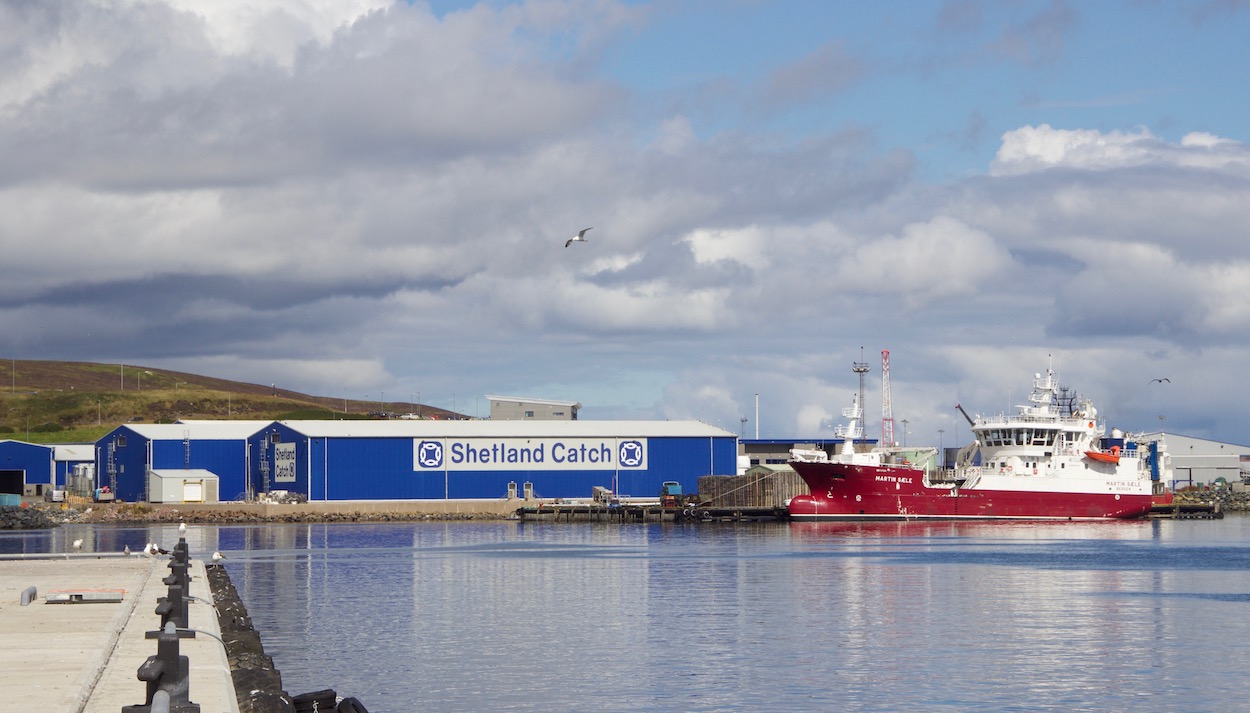
In this environment it is the shoreside processors that can dictate the value of the catch, and dictate the fishing patterns. That is precisely the direction of travel that Shetland fishermen have spent more than a century resisting.
The uncomfortable historical comparison shouldn’t be overstated. No one is seriously suggesting that today’s fishermen are akin to the tenants of lairds, but the old system was characterised by fishermen doing the hard and dangerous work, while other interests exercised disproportionate control over their markets and prices.
The great achievement of the modern Shetland fishing fleet has been to reverse that relationship, but that worthwhile work is being undone before our eyes, and by our own government.
Shetland’s pelagic vessels can now evidence an average price differential of up to £400 per tonne between the prices they are offered in Scotland, and what price the same fish would achieve in Norway – a country which has spent decades marketing quality fish to capture the likes of the high-end sushi market in Japan.
The fish is the same product; Shetland’s pelagic fleet can match any in the world for quality, yet under the current landing target we see Scottish-caught fish consigned to a uncompetitive market – with an uncompetitive price. Does our government agree that Scottish mackerel is a world class product? If so, why have they designed a system that prevents it achieving a world class price?
Fishermen need a strong processing sector, processors need a strong catching sector – their relationship should be symbiotic and mutually beneficial, not forced into a situation where catchers take the risk and processors control the value.
This isn’t an argument against processors – or even foreign-owned processors who have invested in this country. It is an argument for competition between those processors.
That additional £400 a tonne is income which could, and should, be retained in Shetland. A successful Scottish economic link policy would not see that value knocked off a Scottish product.
We have not built a pelagic market system in Scotland that is capable of capturing the full value of the fish – and, as things stand, has no incentive to try.
There is a better way. Imagine a system designed with fishermen, instead of imposed upon them. A system which incentivised vessels from across the North Sea to land into Scotland, and achieved prices for pelagic fish which matched or even exceeded international competitors.
The Scottish Government should retain the ambition of the landing target, but redesign it to reward genuine economic value, rather than simply mandate where fish is landed. Set a meaningful Scottish landing target, establish a transparent international price benchmark for pelagic species and require Scottish processors to offer a price within a set percentage of that benchmark. Where they cannot, then vessels which meet other economic criteria – such as exclusive local crewing – should be exempted from the landing target and free to take their catch elsewhere.
This would give processors an incentive to compete for Scottish fish, and fishermen an incentive to want to land that fish into Scotland. It would give government, processors and fishermen a shared interest in building the markets, infrastructure and reputational brand that this quality Scottish produce deserves.
The best landing target is not one that makes fishermen sell their catch in Scotland. It is one that makes them want to.
That is the progressive economic link that Scotland should be aiming for.