


Radical planning reform needed to tackle constraints, Cambridge professor says

THE HIGH cost and slow speed of re-building the UK’s energy network to link wind farms with centres of population are set to make many of these projects uneconomic.

That is the view of Emeritus Professor David Newbery, a specialist on the regulation of electricity markets.
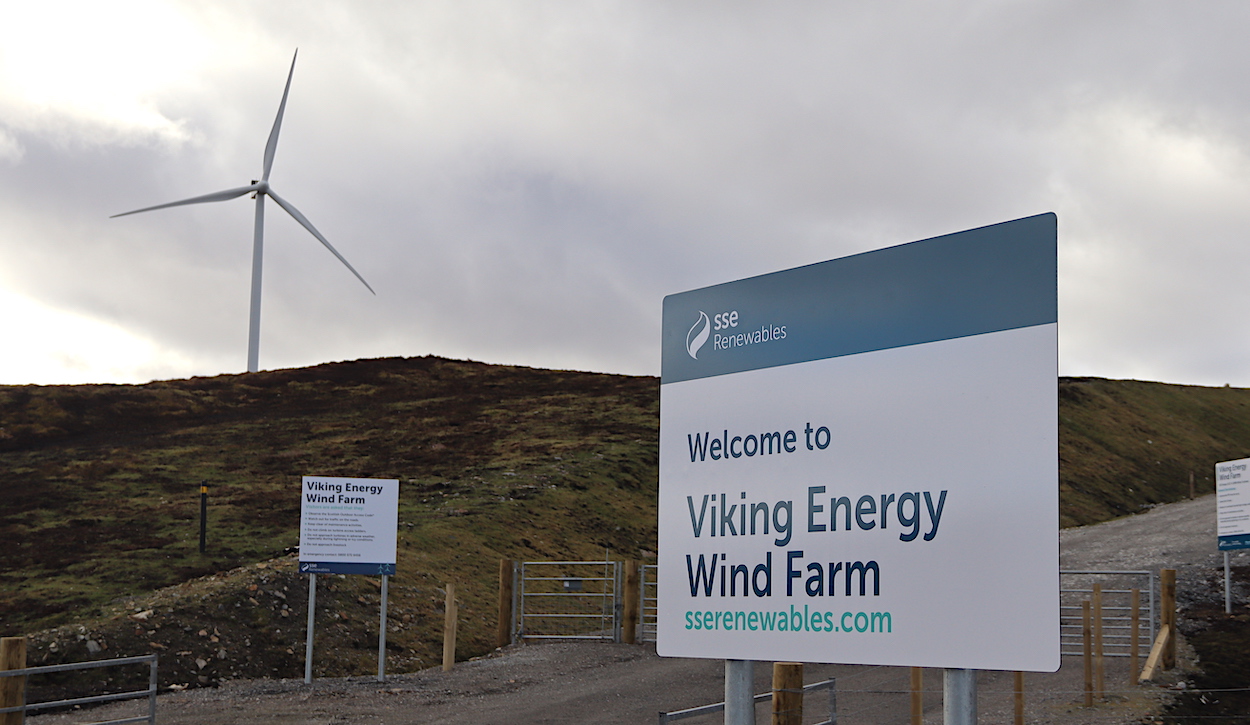
With the cost of transmission constraints now at £1.7 billion a year nationally (£9.1 million for the Viking wind farm in 2026 so far), and rising, these inefficiency charges have become a hot topic.
Speaking to Shetland News earlier this week, Professor Newbery expressed some sympathy for local communities on the isles and across Scotland calling for a moratorium until a proper energy transition plan is in place.
And he agreed with local concerns that any new wind farm built in Shetland may primarily serve to collect constraint payments rather than provide reliable energy due to the current export limitation.

























“If you add an extra wind farm, all it does is push other people off the system, and they get paid,” he said.
In order to overcome the current bottleneck, the director of the Energy Policy Research Unit (EPRU) at the University of Cambridge advocated for an urgent and radical overhaul of the planning system to make building transmission capacity easier.
He said current policies by energy regulator Ofgem and National Energy System Operator (NESO) to favour offshore transmission lines – to avoid conflict with residents – was the wrong way to go, as these were five to 10 times more expensive than building infrastructure on land.
That, he said, would add a further £100 to consumers’ annual electricity bills, and would make wind more expensive than electricity from gas.
Instead, and in order to “not obstruct progress”, he proposes the ideas of:
- Building additional pylons alongside existing ones to minimise visual impact and bypass lengthy planning processes;
- Implementing high voltage direct current (HVDC) lines for long distance bulk power movement;
- Adopting ‘pre-consented corridors or regions’ – similar to other EU states – to avoid individual consent processes for every project;
- Making regulatory changes so that developers cannot connect until sufficient transmission capacity exists.
Help keep Shetland’s news open to everyone

Good local journalism takes time, care and people on the ground. Membership helps us keep reporting the stories that matter to Shetland — and keep them free for everyone to read. Members get a weekly newsletter created especially for them, local ads only, and can bookmark stories and join the conversation in the comments.
He described the Scottish grid as “weak”, with large parts utilising just 132 kilovolts instead of the 440 kilovolts found in the main interconnected systems in England.
Professor Newbery added that upgrading the infrastructure originally designed for centralised coal and coastal nuclear power stations was very slow, as evidenced by the 22-year process to upgrade the Denny to Beauly transmission line.
The “B6 constraints” at the English border also causes significant congestion when wind speeds are high across both regions, he added.
“Due to these constraints, some newer Scottish wind farms face curtailment of up to 50 per cent of the time, doubling their delivery cost,” Professor Newbery said.
“The European Union is very frustrated with the slow rate at which transmission is being built. There’s now a requirement that each country has to look around and say, ‘in which parts of the country would it be environmentally, sustainably and politically feasible to develop wind farms and solar arrays and then designate these whole regions so that anybody who wants to build in these regions doesn’t need additional consent’.
“They’ve been, as it were, pre-consented, and that seems to be a very sensible approach.
“And something similar would be to say, if all you’re doing is building an additional cable by an existing set of pylons, it should not need the whole tremendously complicated process of citizens’ involvement (…) and all the other things that have to happen before you can do anything anywhere.
“I would argue that it could be done legally quite quickly.”
He added that without reform, consumers would continue to be “shovelling money out to multinational companies”.
Citing the Irish solution to constraint payments, he added: “[Wind farms] can connect in places which have adequate capacity, but if you connect in one of the other places, we won’t guarantee you that you will be paid if you can’t export.
“So when you’re curtailed, that’s your loss, not ours. We don’t have to compensate you.
“In the case of a new wind farm in Shetland, if the existing wind farm has already been guaranteed a firm capacity connection, any new ones would (…) only get paid if they can actually generate.”
Keep Shetland’s news open to everyone
Your membership helps us report the stories that matter to Shetland — and keep them free for everyone to read.