

Crash barriers and road signs may need removed for turbine delivery to Neshion site
SIC roads manager ‘very reluctant to agree’ to removal of barriers

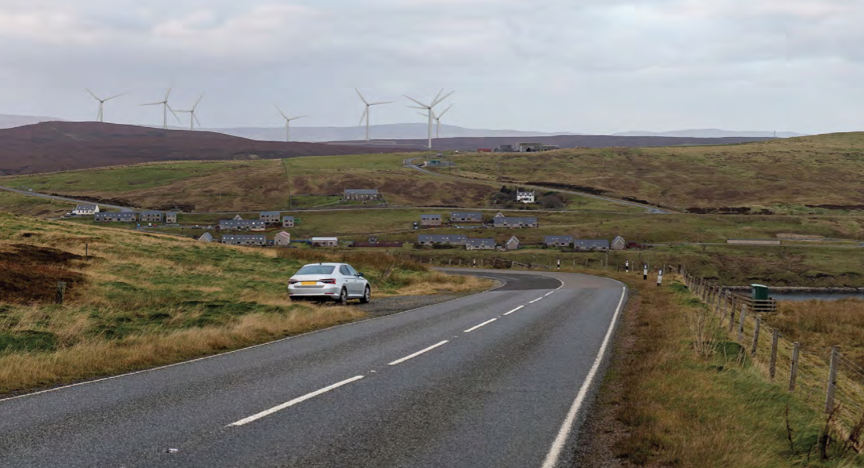
A NUMBER of streetlights, road signs and small sections of crash barrier may have to be temporarily removed to allow turbine blades to be transported to the proposed Neshion energy park in the North Mainland.
The turbines are proposed to be 200 metres high from bottom to the tip of the blade, which would make them the largest in Shetland.
The blades themselves would reach around 84 metres in length.
The impact of abnormal load deliveries which would be required for construction at the site near Sullom Voe Terminal (SVT) have been detailed in a document contained within its planning submission.
In response Shetland Islands Council’s (SIC) roads manager Neil Hutcheson said he would be “very reluctant to agree” to the removal of safety barriers.
A total of eight turbines – expected to be the Vestas V172 model – are proposed for the energy park, which is being developed by Shetland Aerogenerators, with 25MW of battery storage also planned.

























North Mainland energy park reduces turbines in response to community feedback
As part of the planning process, an assessment of abnormal load routes has been undertaken by consultants.
It is expected that the turbine parts would be landed at Lerwick Harbour, similar to the Viking wind farm construction, but the Port of Sullom Voe is also being considered as an alternative.
However the planning document reiterated that Sullom Voe has not been used to import large-scale onshore wind turbine components before.
The assessment has highlighted a number of “pinch points” if blades are transported by road, mainly from Lerwick – leading to the potential for so-called street furniture needing to be removed.
Abnormal loads for wind farms is nothing new for Shetland, with parts for the 103-turbine Viking development in the central mainland transported by road under escort.
Specialist contractors were brought to Shetland to transport the turbine blades, with tight corners at times offering logistical challenges.
Echoing the Viking abnormal loads, the assessment looked at Neshion turbine parts beginning their journey on specialist trailers at the Greenhead Base in Lerwick.
They would then head north and go through the Dales Lees road before taking the left junction near Firth which heads towards SVT and the gas plant.
A total of 23 pinch points have been highlighted on the route from Lerwick, with some not requiring any street furniture to be removed.
But a number of the pinch points would require action, with the junction near Firth – where the A968 meets the B9076 – one of the most affected.
It is suggested that three bollards, a road sign, two utility cabinets and 6.5 metres of crash barrier would need to be removed to allow the abnormal load to pass.
Turning right from Gremista onto the A970 near to the power station in Lerwick could also require six streetlights, eight bollards and three road signs to be temporarily removed.
There may also be a few occasions where temporary hardstanding overrun areas are required, and instances where there would be “over-sail” of third party land.
Four pinch points have been recorded on the much shorter route from Sullom Voe to the development site.
The document concluded: “The abnormal load assessment has identified that the routes from both Lerwick and Sullom Voe to the site are technically feasible in terms of horizontal geometry, which is anticipated to be dependent upon third-party land agreements at around 12 locations.”
It is also recommended that further engagement is undertaken with Lerwick Port Authority and the SIC.
The document also said “all hedges, shrubs, bushes, trees and overhanging branches along the nominated routes” must be trimmed from within carriageway verges.
Police escort or a pilot car would be required to accompany abnormal loads, while “full carriageway widths must be available along the entirety of the route”.
Responding as part of the planning process, roads manager Hutcheson said there would need to be measures put in place so “signs are in sockets and lighting columns are hinged”.

“I would be very reluctant to agree to the removal of safety barrier and so, if this really is required, discussions over how road safety is to be maintained will be required well in advance of the movement operations,” he added.
Hutcheson also requested a construction traffic management plan be provided prior to works commencing, which the developer has already proposed.
Generally, he said that it is clear “a lot of work and planning” has been undertaken to minimise trips on the public network during construction.
This includes through the creation of a borrow pit to source aggregate, and identification of areas of peatland to restore to re-use extracted peat.
During the peak month of construction, it is anticipated that approximately 74 two-way HGV (heavy goods vehicle) movements, and 60 two-way car/light goods vehicle movements would take place each day.
It has been suggested that the increase in total traffic on all assessed road links would be less than ten per cent.
As the total generating capacity of the proposed development is more than 50MW, the final decision on planning consent lies with the Scottish Government.
Plans were submitted recently, with the developer hoping to receive consent for the project next year with a view to starting construction in 2029.
The company is looking at establishing a “private wire” with SVT as it has already signed a Memorandum of Understanding (MoU) with EnQuest subsidiary Veri Energy on a synthetic fuel development at the terminal.
Neshion is also hoping for a grid connection via a proposed northern hub station.
In its planning application statement, the company said its 58MW wind farm and 25MW BESS project could – over its 40-year lifespan – generate as much as £310 million to the economy, comprising £35 million from direct employment and £275 million from indirect economic effects.
Once operational, the facility would sustain an estimated 12 skilled roles and £2.55 million in annual local expenditure, the company said.
Neshion has also confirmed its commitment towards introducing a Local Electricity Discount Scheme (LEDS) to provide financial relief for eligible households in the nearby area.