
Work underway to explore providing discounted electricity using surplus wind energy
The SIC is engaging with a range of other organisations including GB Energy, Ofgem and SSEN on its Shetland Community Power Project


A PROJECT is being developed to test using surplus wind energy in Shetland to provide cheaper electricity to houses and businesses.
The project is initially being led by Shetland Islands Council (SIC), with a working group set up including representatives across the energy sector and beyond – from SSE to regulator Ofgem, GB Energy to the University of Strathclyde.
The SIC’s future energy and climate change manager Claire Ferguson said there is a feeling in the community that it is “unjust” how Shetland has a high level of fuel poverty despite hosting large scale energy production – like the Viking wind farm, which sometimes cannot export electricity due to bottlenecks on the grid down south.
Wind farms are given constraint payments to switch off their turbines when there is not enough capacity on the grid, with SSE given millions through this for Viking.
Ferguson said the new Shetland Community Power Project was started after the UK Government announced in March a desire to see curtailed energy used to provide more affordable energy for communities.




















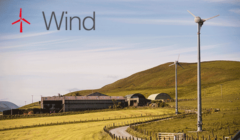







“When that announcement came out, it felt like something that Shetland should absolutely be front of the queue for, given the amount of large scale energy that we are hosting – the scale of energy generation in Shetland is far in excess of our local demand,” Ferguson told Shetland News.
Potential solutions could include private wire connections, energy storage and hybrid heat networks, with a focus too on local flexibility.

A brochure given out by the SIC to policymakers – including GB Energy on their recent visit to Shetland – said that “working with industry, communities and academia, the project would develop an implementable plan for making better use of surplus renewable power, while exploring the viability of a Shetland tariff in the context of large-scale energy development”.
Help keep Shetland’s news open to everyone

Good local journalism takes time, care and people on the ground. Membership helps us keep reporting the stories that matter to Shetland — and keep them free for everyone to read. Members get a weekly newsletter created especially for them, local ads only, and can bookmark stories and join the conversation in the comments.
The idea of a ‘Shetland tariff’ has been spoken about for years – the concept of reduced energy bills for islanders given the isles hosts the 103-turbine Viking wind farm.
Scottish first minister John Swinney previously said he was sympathetic to this call, but said the energy system – reserved to the UK Government – needed reform.
Northern Isles MP Alistair Carmichael previously said the UK Government announcing a trial programme in March which would enable suppliers to offer households and businesses discounted electricity during periods of constraint could be a way of delivering a ‘Shetland tariff’.
It was indeed this government announcement that was the catalyst for the Shetland Community Power Project. At this stage it is fairly high level, with not too much able to be said publicly when it comes to the finer details.
But Ferguson said there is a hope that projects could be trialled from 2028.
“At the end of phase one we will have a costed plan and business models for what projects and trials could be put in place, and we would be looking to put trial projects in place in the five following years,” she said.
She said 40 per cent of Shetland households are in fuel poverty, with 29 per cent in ‘extreme’ fuel poverty.
With a 103-turbine wind farm on their doorstep, which has blades that are not always turning, Ferguson said the feeling of injustice in the community is a “big part of what feeds in the narrative” of why Shetland should be at the front of the queue for any curtailed energy projects.
The brochure also said that “bridging the gap between energy generation and affordability is no longer just desirable – it is essential”.
It comes as more energy projects are on the horizon, including onshore wind farms, offshore wind development and ammonia production.
The working group for the community power project includes representation from both the transmission and distribution arms of SSEN.

Highlands and Islands Enterprise (HIE) is also on board, alongside Strathclyde University and Hjaltland Housing Association.
Perhaps crucially it also appears to have interest from organisations with a stake in how the UK energy system works; Ofgem and the government-owned GB Energy is joined in the group by grid operator NESO.
“The idea was that we get everyone across the energy system who would either have an active part to play or a policy part to play in enabling a project to happen,” Ferguson explained.
“What we really want to look at with this project is the relationship with transmission and distribution.
“Hopefully through involving everyone at the earliest stages of the project we can get to a place where there is something at the end of this first stage, which is the investigation and feasibility stage, where we can actually implement a meaningful project.”
A second phase of the project could include looking at “tariff solutions” – potentially implementing a trial linked to surplus energy in Shetland.
Ferguson said another key element is looking at how community energy generation can be a part of the wider system, with storage forms – such as more district heating or battery systems – mooted.
The aim would be that community projects benefit from excess energy in the system, making them more economically viable and resilient too.
The brochure to policymakers said that Shetland is an “ideal location for smart local energy systems”, calling on GB Energy to establish an investment programme for local energy in Shetland.
Ferguson also said more affordable energy in Shetland could mean businesses could decarbonise at a quicker rate, adding that high-demand projects are on the horizon – such as SaxaVord Spaceport or some of the initiatives proposed at Sullom Voe Terminal, like e-fuel production.
Meanwhile a sounding board has also been created to provide oversight and scrutiny to the various energy works planned in Shetland.
This board includes councillors and SIC officials as well as representatives from the likes of HIE, UHI, Lerwick Port Authority and NatureScot, as well as the local engineering alliance Norn.
The SIC’s briefing to policymakers, which was also given out at the recent SNP conference in Aberdeen, said Shetland’s energy system differs to other parts of the UK.
It highlights Shetland has no access to mains gas and requires high levels of investment to improve the energy efficiency of buildings.
The brochure said future energy development in the isles “places Shetland at the forefront of the UK’s energy transition”.
“However, while Shetland exports large volumes of clean energy, many local households and businesses, and indeed community-led clean energy projects, are not feeling the benefits.
“Shetland Islands Council believes that there is a fairer and more efficient way to ensure that communities can participate in the energy transition, and we believe coordinated action from the UK and Scottish governments, working with Ofgem, the National Energy System Operator (NESO) and distribution network operators and transmission operators, can assist us to that end.”
The brochure added that without targeted policy, regulatory reform and collaborative work between governments, “the benefits of this transition will continue to flow out of the islands, to the severe detriment of our communities”.
Keep Shetland’s news open to everyone
Your membership helps us report the stories that matter to Shetland — and keep them free for everyone to read.