
‘Moratorium and Shetland energy act could proceed together’ – reactions to Saturday’s meeting of community councils

THE ASSOCIATION of Shetland Community Councils (ASCC) is set to keep pushing for a moratorium on new energy developments in Shetland following Saturday’s energy convention.
Event organiser and ASCC vice chair Andrew Archer said he was “disappointed and not at all surprised” by the outcome of the meeting, but pleased that it took place and that more than 80 people attended.
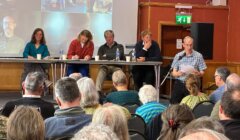
Meanwhile some of those who attended have given their reaction to the convention which was held in Room 16 at Islesburgh Community Centre.
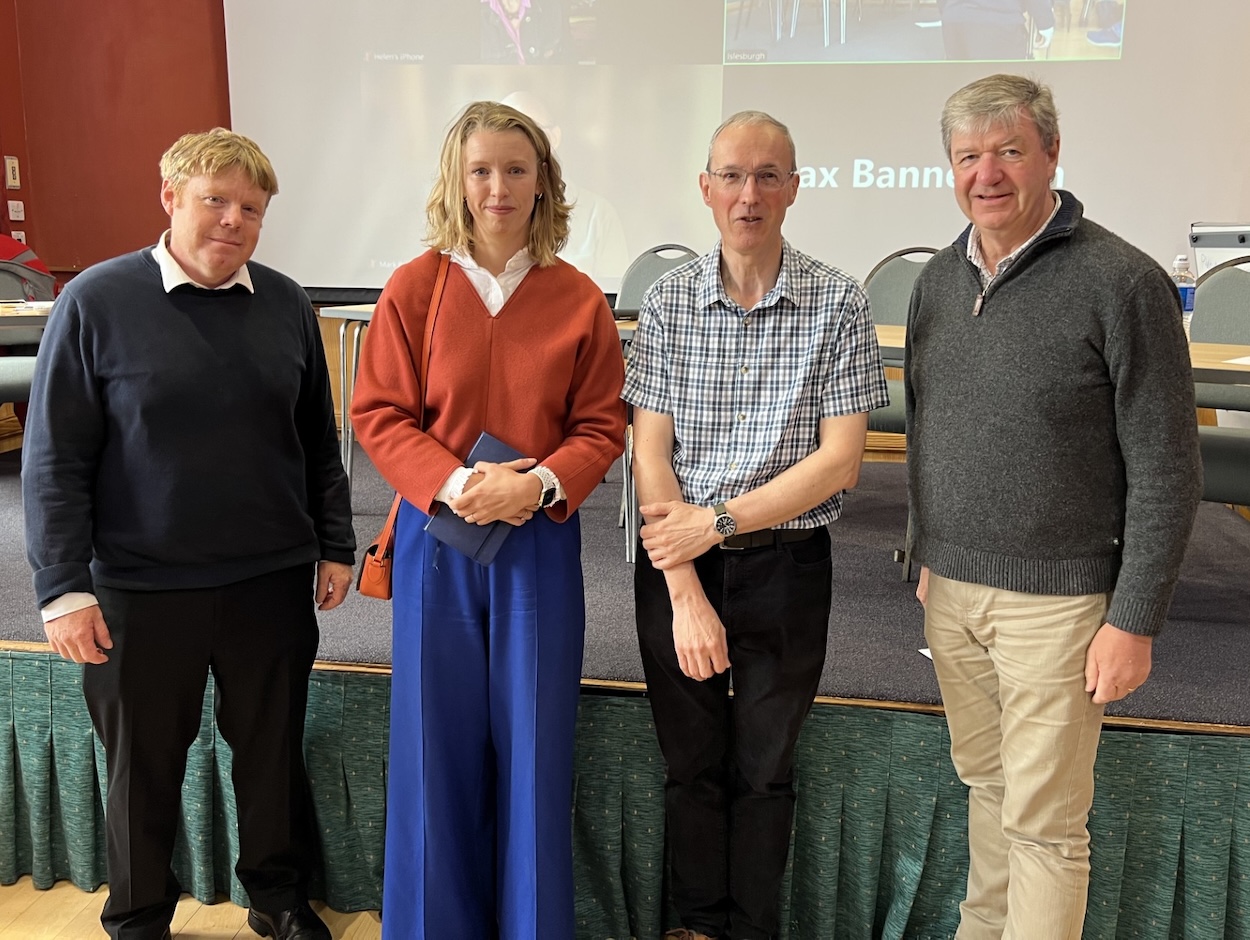
Photo: Ross Cowper-Fraser























While there was unity among community councils present in support of a temporary pause, both Shetland’s elected representatives, Hannah Mary Goodlad MSP and Alistair Carmichael MP, felt unable to sign the ‘unified statement’ calling for a moratorium.
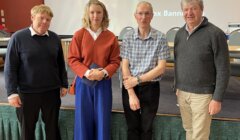
The two regional MSPs who attended the meeting, Max Bannerman of Reform and Conservative Tim Eagles, did back the motion.
Yell resident Adrian Brockless said the unified statement was in no way anti-renewables.
It simply asked government to stop consenting interconnected developments piecemeal before anybody has properly examined what they collectively mean for rural communities, he said.
“Yet Alistair Carmichael MP and Hannah Mary Goodlad MSP both refused to sign it – without identifying any central demand they actually opposed,” Brockless said.
“Mr Carmichael later accepted that the statement could be adapted into a Shetland version while remaining part of the wider national initiative.
“His objection was, therefore, a reason to amend or strengthen the statement, not a reason to reject its central demands.”
He added: “Given Mr Carmichael’s legal training, it is difficult to accept that he genuinely regarded the omission of one illustrative industry as a logical obstacle to supporting the statement’s central demands.
“If there was another reason for his refusal, constituents are entitled to hear it.”
Brockless described Hannah Mary Goodlad’s explanation as “equally unsatisfactory”.
“She has spoken repeatedly about ownership, local control and her proposed Shetland Energy Act. But the unified statement says nothing about community buy-ins or shared ownership. Those are separate questions,” he continued.
“Ownership does not answer whether further major applications should proceed before their combined impacts are understood.
“Nor does a financial stake make an unsuitable development acceptable. Ownership cannot substitute for planning: a community share in the wrong development, in the wrong place or at the wrong scale does not make it right.
“There is also no conflict between a Shetland Energy Act and a Scotland-wide pause. They could proceed together.
“Indeed, a moratorium would provide the breathing space in which the local powers and protections Ms Goodlad advocates could be developed before still more projects are consented.”
He added: “Their reasons were reasons to add to the statement, not reasons to reject it. On the explanations they gave, both failed to represent the central request placed before them.
“They should now say plainly which of the statement’s substantive demands they oppose – or reconsider their refusal to support it.”
Politicians stop short of backing energy moratorium and call for Shetland specific plan
Meanwhile Rosemary Macklin of campaign group Sustainable Shetland said she was pleased that community council had spoken with a united voice but felt that local parliamentarians have missed an opportunity by not endorsing the motion.
“The refusal to sign the statement by the SNP MSP wasn’t entirely unexpected, given the government role she has been given by John Swinney and the SNP’s current policy regarding renewables,” she said.
“Our MP (…) seemed to acknowledge the significant contribution Shetland has made so far in the renewables sector, still stopped short of actually agreeing to sign the statement as he considered it not to be Shetland-centric enough.
“Any changes to the statement would need to be made by the Association of Shetland Community Councils but the whole point of the meeting was to join other community councils in Scotland to request a halt to further developments until a coherent plan for renewables is put in place.
“Surely that’s not too much to ask of the Scottish Government as they are there to represent the people of Scotland.”
Macklin added that the group’s islands wide survey on future energy projects has so far generated around 2,000 responses with a vast majority of 85 per cent in favour of a moratorium on future developments.
She said the survey, which has been sent to every household in the isles but is also available online here, will close on 6 September.
The council responds
Meanwhile the SIC’s political leader Emma Macdonald and her deputy Gary Robinson said in a joint statement that the council takes the concerns raised about community engagement and the cumulative impact of development seriously.
“It is important, however, to distinguish between the council’s role as a planning authority and the wider policy and regulatory decisions that are the responsibility of the Scottish Government and other statutory bodies,” statement reads.
“Where the council is the planning authority, elected members must determine applications in accordance with the relevant planning legislation and development plan, taking account of material considerations and the representations received.
“The council cannot lawfully determine an application simply on the basis of whether a development is popular or unpopular locally.
“Nor can the council impose a moratorium on developments where the statutory planning and consenting framework does not give it that power. Some energy developments are also subject to consenting regimes beyond the Council’s direct control.
“That does not mean that communities are without influence. Community views form an important part of the planning process, and the council continues to encourage communities to engage with applications and with the preparation of Shetland’s next Local Development Plan.
“The council also recognises that the cumulative impact of development, community benefit, infrastructure, environmental protection, and the distribution of economic benefits are wider policy issues which require action beyond individual planning decisions.”
With regards to the next steps Archer said Saturday’s meeting had been an ASCC event, and as such it was for the membership to define the way forward.
He said community councils would now likely be looking at ways of working with the national movement of community councils that is lobbying for a pause in development.
Highland councillor and the driving force behind the first community council convention in Beauly in June last year, Helen Crawford, said Shetland community councils are welcome to join the national movement.
She added that party politics was hindering the conversation and the calls from rural Scotland to be represented by their MPs and MSPs.
“The community council convention is of all parties and none, and they are sitting at the table together,” she said.
“The target is to sit down with [cabinet secretary for climate action and rural affairs] Gillian Martin and with Hannah Mary Goodlad and other key people, and to be heard.”
Archer added: “As we said on Saturday, change will only come if we get our politicians to change the rules and that is still the goal.
“There did at least seem to be consensus that communities need to get a much better deal out of things, and I think that the reality is that we are more likely to see change there than in stopping the juggernaut of development that is bearing down on us.
“Having said that, the other area where I think that we can make progress is in getting greater representation for communities is things such as the National Energy System Operator’s (NESO) strategic spatial energy plan.
“I have written to Hannah Mary Goodlad this morning to see how we can work together on that.
“As for the unified statement, Alistair Carmichael very kindly offered to create a more Shetland-centric version of it after the meeting on Saturday. He sent me a draft this morning (Monday) so we will progress work on that.”
He added: “We’ll keep on pushing. We know it’s an uphill struggle but, as I said before the event, if we don’t try, the chance of us changing anything is zero. We have to keep on.”
See also: