


A dialect of Scots or a variant of a Scandinavian language?

Discussion about the form of speech used in Shetland goes on. Is it, as I believe, a dialect of Scots? Or is it a variant of a Scandinavian language? I am not too worried about these questions, because I think the answer is obvious.
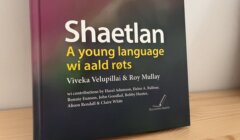
There is an interesting discussion to have about its viability as a means of communication. The versions of it that I have seen in the media recently are translations from English using a Shetland dictionary.
A few months ago Mark Smith wrote about Shetland writing, and how it should be studied – and hardly ever is.
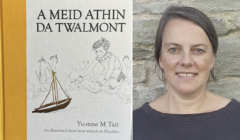
In my opinion, two of the most thought-provoking Shetland texts are translations of children’s books. One is by a language expert and the other by a Shetlander who knows about grammar.
Derick Herning’s Jarm and Jeemsie, published in 1984, is a translation of Wilhelm Busch’s Max und Moritz (1865). Derick was a native of Fife who understood Shetland dialect like a native. There is not a Shetland word out of place in the book. Derick appends to his brilliant rendering a useful ‘wirdlist’, where he shows that much of his Shetland vocabulary is Scots, with a sizeable number of Scandinavian words.























My other example is Laureen Johnson’s translation of Lewis Carroll’s Alice’s Adventures in Wonderland (2012). It is another masterpiece, the work of a native Shetland speaker. I am a particular admirer of what she makes of the poem with which Carroll prefaced the work.
Here is a verse: ‘So dis is foo da story grew/Da tale o Wonderlaand,/An aa da uncan happenins/Ta aa dat uncan baand/Till, come da hömin, we at last/Cam lichtsomely ta laand’.
When these books were published, I’m afraid to say, they scarcely got a mention locally. They are worthy of the closest study by enthusiasts for the Shetland dialect. In particular, the spelling of Shetland words in them is rational.
Nowadays there is a tendency to spell the words in such a way to make them look bizarre: not something that is helpful.
If the Shetland dialect has a future, it will have to remain accessible to readers as well as speakers.
Brian Smith
Weisdale