


Could Shetland host a data centre in the future?
The former Scatsta Airport building was once explored as a potential data centre site, and there have been enquiries about Lerwick too – but is it feasible?

SHETLAND can at times feel a long, long way from the technological hubbub of cities and the mainland.
But could the isles play host to a data centre in the future?
Data centres are in effect warehouses which host vital infrastructure required for today’s digital activity, including ‘cloud’ data storage.
There is growing unrest in other parts of Scotland, however, around plans for more large data centres, with some designed to facilitate the expansion of AI (artificial intelligence).
Located hundreds of miles away from the mainland, Shetland may feel like an off-limits location for a data centre – especially those larger in size.
However the former Scatsta Airport building in the North Mainland was previously assessed as one of many possible locations for data centres in Scotland, although this was not taken forward.
A report, compiled by the Scottish Futures Trust, said Scatsta would have “easy data centre development with compatible industrial planning zoning” and international connectivity through Faroe’s SHEFA subsea cabling, which runs to and from Shetland.


























Shetland Telecom’s Marvin Smith also revealed that data centres have been an “ongoing subject” locally for more than 15 years, with a number of enquiries made during this period.
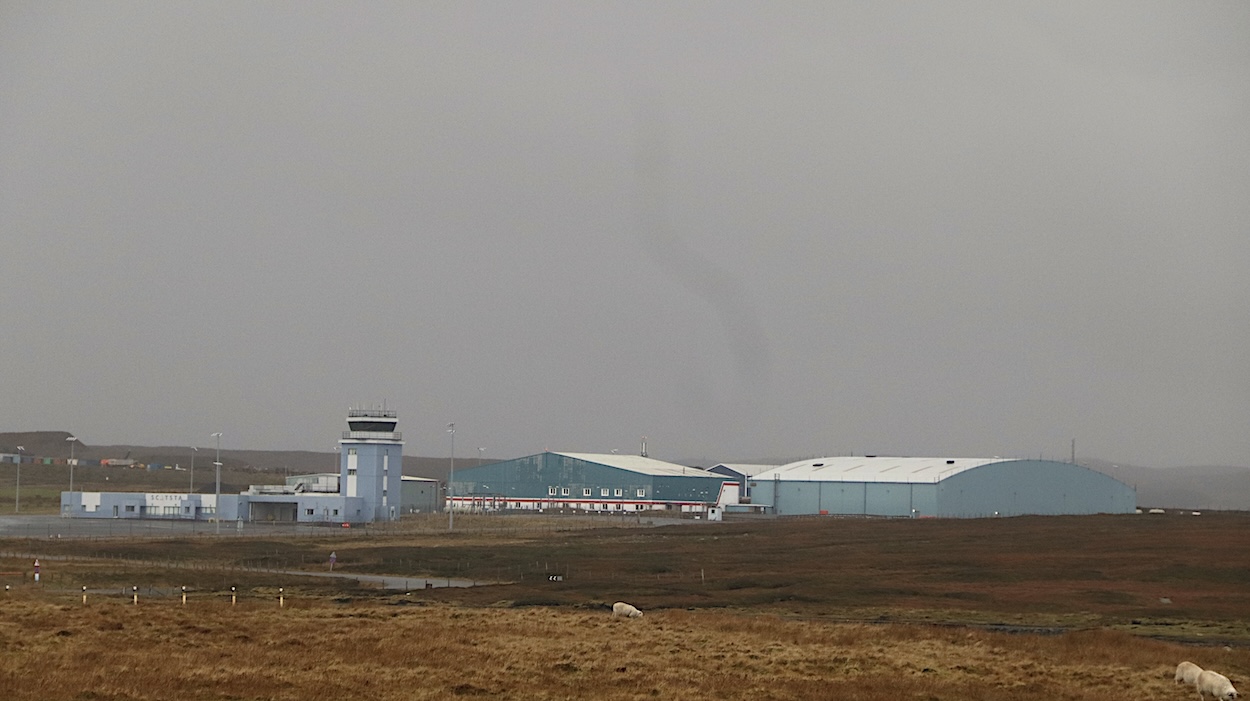
Scatsta was the most recent, but there have also been enquiries about hosting data centres in Lerwick in the past.
Those concerned about a huge data centre appearing in Shetland should not get too worried, however, with Smith reckoning a small-scale, modular set-up would be more likely – if one ever came to fruition.
The vulnerability of subsea telecoms cables to Shetland, which have suffered breaks in recent years, is also a key limiting factor.
Help keep Shetland’s news open to everyone

Good local journalism takes time, care and people on the ground. Membership helps us keep reporting the stories that matter to Shetland — and keep them free for everyone to read. Members get a weekly newsletter created especially for them, local ads only, and can bookmark stories and join the conversation in the comments.
Vodafone, however, announced last year plans to assess the feasibility of a new telecoms cable to Shetland, which it said could open up new opportunities like data centres.
This was followed by an election manifesto pledge earlier this year by the SNP to also explore the idea of another cable to Shetland.
Smith explained that to “make the internet work”, a certain level of data centres are needed – with hundreds already in the UK.
“There’s quite a few in Scotland now, but for a long time they were all based really in the south of England,” he said.
“The problem with those sites are that they use a lot of energy and a lot of water – or they use a lot of energy for the air conditioning, and they take up land.”
Smith said Scatsta was looked at as it had available land, and could have potentially linked into renewable energy, such as offshore wind which is likely to come into mainland Shetland.
And the cooler Shetland climate, he added, meant air conditioning would not be as much of an issue.
“Every couple of years there’s somebody that comes along looking at the potential for data centres,” Smith continued.
One of the first enquiries was around a data centre in Lerwick, which had an environmental angle through the idea of offering heat from servers to the town’s district heating system.
“The problem with that solution was that it came at the time of the market crash, so people stopped looking for green and started looking for cheap – so that’s why it never happened.”
In more recent years there was an enquiry about hosting a shipping container sized data unit in Lerwick which could have been expanded in a modular fashion.
But, as Smith says, one of the most important factors for a data centre is the strength of its outward connections.
Shetland and communications blackouts have been in the news all too frequently in recently years as a result of damage to subsea cables, and this will not give confidence to the tech market.

“It would be unlikely you’d see one of the big players like Microsoft investing in a data centre in Shetland because the amount of press we had when we had the subsea breaks,” Smith said.
“That would be offset if Vodafone were to put in a third cable, so it could then potentially open up that market again.
“But at the moment I don’t see it being a viable thing for just now, because we need to build up that reputation again as a well connected community.”
Hypothetically, Smith said he could envisage a centre in Shetland hosting ‘cloud’ storage – where people can save data not on their hard drive or phone memory, but in the digital-sphere.
“Why spend an absolute fortune storing your photos in the south of England when that same photos could be stored in Shetland at a much much lower cost, because the cost of land in the south of England is so high?” he said.
Smith added that if a Shetland data centre meant cloud data took an extra “24 milliseconds” longer to access, it would not make a difference to the user.
“The other market that creeps in every now and again are things like very sensitive data, such as government data,” he continued.
“It’s safer to hold that ‘offshore’ – Shetland is offshore but also within the UK jurisdiction, so the markets see that as an advantage as it’s the same laws as everywhere else, so it’s an advantage over them using somewhere like the Channel Islands, because they have their own laws, or storing it abroad.”
Around eight years ago Microsoft trialled a novel data centre concept in Orkney, which involved lowering a subsea module 117 feet deep onto the seabed.
So could a data centre in Shetland be likely? “No, not for now,” Smith responded.

“I don’t think there is the business case or the need for it at the moment. But until the backhaul is better supported, then we certainly wouldn’t be in the market for ‘tier one’ data centres.”
He said smaller centres such as the shipping container types would be more likely.
There is growing concern elsewhere in Scotland, however, about a number of much larger, new data centres proposed, mainly in the Central Belt.
Linked to advancements in AI, these have been described as ‘hyperscale’ projects both large in size and energy demand.
The Scottish Green party has called for a moratorium on new data centres in the country, saying 24 proposed units would together consume more than 1.5 times Scotland’s total peak power use.
“Within limits, data centres are an essential part of modern infrastructure,” they said.
“But at a time of rising energy prices and stalled climate action, an unplanned expansion could have huge impacts on both people and planet, and the huge scale of expansion is mostly about enriching giant AI companies.”
Shetland MSP Hannah Mary Goodlad has become involved in the process by nature of her government role of public finance minister including planning matters.
A new direction was issued by Goodlad in August which will require planning authorities to notify Scottish ministers of new data centre applications exceeding 50 megawatts power capacity within seven days of validation.
She said “We must balance the economic and employment interests in developing data centres with national energy, climate and community wealth building ambitions, which are vital to our future prosperity, as well as the potential impact on local communities”.
For now, though, a more pressing matter on Smith’s radar remains improving the subsea links to Shetland.
“We need more cables, or we need the cables that are in place to remain viable,” he said.
Smith also welcomed the SNP’s pledge to look into the feasibility of a new cable to Shetland, but said it does not matter which party is shouting for it – “we need to set politics aside and support it”.
He also referenced international cables which are planned to run from the likes of America, Greenland, Iceland and Faroe, and questioned if Shetland could be involved too.
“There’s certainly a huge conversation that needs to be happening about seabed cables,” Smith said.
“Satellite solutions are fantastic, but they’re not the long term-future for the renewable energies or oil or energy production or salmon farming or fisheries – all that in the future is going to rely on cables, just for security reasons if nothing else.
“You always get more capacity through cables than you will get through the air, so for Shetland’s economic future, we really need to be putting in a lot more work with the governments etcetera about funding for more cables, or ensuring the ones that we’ve got are better protected.”
Keep Shetland’s news open to everyone
Your membership helps us report the stories that matter to Shetland — and keep them free for everyone to read.