
Real transition required immediately

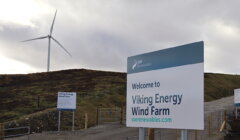
It is encouraging and heartening to see community councils getting together to formulate opposition to wind turbine and other “renewable” energy developments driven by transnationals who have absolutely no interest in the communities they continue to desecrate.
Community councils to lobby politicians on energy development concerns
However, I fear that any expectation communities could benefit from such developments is misplaced, given the model presently operating, in which a remote transnational, SSEN, controlled by remote institutional investors, owns both the electricity distribution and transmission networks.
The best that can be hoped for is loose change in comparison to the profits made by the transnationals that own the networks.
There can be absolutely no doubt that energy and electricity strategies and policies must be developed nationally to meet local requirements, suggesting a publicly-owned entity controlling the distribution and transmission networks, which was what existed prior to the economic madness that started post-May 1979.


















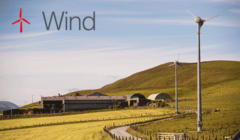







If the meeting on Saturday can achieve consensus on joining other like-minded groups requesting a moratorium on all renewable development; particularly the infrastructure that blights communities across the length and breadth of Scotland; until a time-limited and tightly-focussed national inquiry is convened and concluded, that will be a major step forward.
Given the evident and disastrous results of human-induced climate change, there isn’t time to waste on navel-gazing for another decade or two while often self-appointed experts dance around on the heads of pins engaged in esoteric discourse on whether or not action is required.
Action and real transition is required immediately.
The argument that hydrocarbons have to be part of the mix for the foreseeable future is no longer tenable. As long as it prevails, there can be no transition, but rather addition to available energy capacity that is not required.
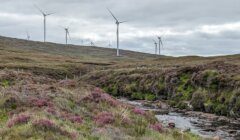
Wind turbines and their required infrastructure are ineffective, inefficient, environmentally and societally damaging, and comparatively short term.
The optimal solution presently appears to be use of SMR (Small Modular Reactor) powering localised grids designed to meet the varying needs of the communities they serve across the UK.
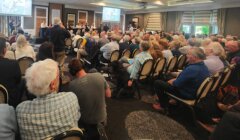
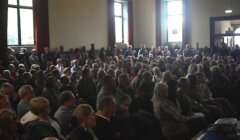
Meetings such as that planned for Saturday in the world-famous Room 16 provide an unrivalled opportunity to get that message across to politicians who clearly have their own agendas.
Leslie Sinclair
Kirkwall
Orkney