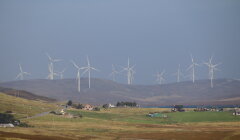



Viewpoint / Local communities excluded from gaining a meaningful stake in the clean energy transition
In this slightly longer piece, energy consultant Daniel Gear unpicks the UK Government’s ‘Local Power Plan’, published on Monday, and finds that it neither empowers communities in energy rich areas such as Shetland nor tackles the obstacles that prevent communities from claiming a meaningful stake in the transition.


On Monday, the UK Government and Great British Energy (GBE) launched the Local Power Plan, which commits “up to £1 billion” to support community-owned clean energy, with a vision that by 2030 every community will have the opportunity to own a local energy project.
I’m pretty much the target audience for this. I run an energy transition consultancy. I co-authored the Just Transition Commission’s research report on community benefit and the energy transition.
And I live in the South Mainland of Shetland, in a community that – at this very moment – wants to do exactly what this plan says every community should be able to do.
In every analysis I write – and in the age of techno-tribalism – I feel a compulsion to re-state that I am not against energy developments. What motivates and concerns me is the belief that government and industry are heading down a path that generates more-and-more immovable opposition, not because people are anti-progress, but because the current model of development is extractive, and people can see that it is.



















I regularly preach to my colleagues that the energy transition behaves like a non-Newtonian fluid: the harder and faster people try to push developments through communities, the firmer the resistance becomes. A different approach is needed, and I had hoped the Local Power Plan would be it.
So, on Monday night, I read the plan… Then stayed up all night writing this.
One million dollars! (or was it a billion quid?)
Before getting into the detail of this, I had to go back and check what Labour actually said in their 2024 manifesto. I was sure that the pre-election Local Power Plan committed to £1bn *per year*, rather than the £1bn across the three year spending review period.
Yes, it did say that; £600 million in grants to local authorities and up to £400 million in low-interest loans to community organisations per year.
That would deliver 8GW of community energy by 2030, a million new energy owners, and 20,000 new projects. That was the offer to the electorate. Admittedly that was before the discovery of the financial black hole, so maybe some of the original commitment was spaghettified.
In the Local Power Plan (shortening now to LPP), the grant/loan split is not specified. The 8GW target, the million owners, the 20,000 projects, none of these appear in the published plan.
This could be because that detail is being held back until the “GBE Capital Toolkit” launches in Summer 2026, following what is described as a “product design sprint” with the sector. “Product […] design […] sprint”.
(@Voar employees, consider this notice that this term now falls into the same category as “off island”, or mistaking community benefits with community wealth, and that uttering or writing the term is the linguistic equivalent of pishing in the kirk porch, and will result in your summary dismissal. THANK YOU FOR YOUR ATTENTION TO THIS MATTER).
It’s unclear whether the £1bn includes the roughly £304 million in programmes already committed, specifically, the £255 million Solar Partnerships Scheme, £16 million Mayoral Renewables Fund, £21.5 million in devolved partnerships, £5 million Community Fund.
Whether these sit inside or outside the headline figure is not stated, although the inclusion of detail on these projects probably implies they are already part of the £1bn.
The consent… problem
Monday’s article in the Guardian by Severin Carrell (“Miliband pledges up to £1bn for community green energy schemes”) made a good job of framing the political motivation that sits behind the LPP.
To summarise: Ministers hope community ownership will combat growing opposition to energy infrastructure (pylons, wind farms, substations, etc.) particularly in rural areas now being courted by the Conservatives and Reform UK.
Their logic is straightforward: giving communities a stake will help them to support the infrastructure. It’ll grease the wheels. Miliband said the correct words: “we want you to be able to own and control clean energy so the profits flow into your community not simply out to the big energy companies.”
The challenge now is that the mechanism has to actually work in the places where consent matters most – the communities hosting the infrastructure. And this is where the plan risks falling apart.
Gridlock
In England and Wales, community energy projects of up to 5MW can connect to the distribution grid without a Transmission Impact Assessment (TIA). This was following a rule change – CMP446 for the boffins – in May 2025. This means that a community group in Bristol or Barnsley can now develop a meaningful project and connect it without effectively having to enter the transmission queue.
On the Scottish mainland, that threshold is now 200kW. On the Scottish islands, where I live, it’s 50kW.
That means a community in England can connect a project 100 times larger than anything a community can build in Shetland.
Any projects above those thresholds get drawn into the connections reform queue; the Gate 1/Gate 2 system. The National Energy System Operator (NESO) paused new applications in January 2025, and connection dates for any new projects in this part of the world are 2035 at the earliest (remember the target of 8GW of community renewables by 2030).
“Communities can’t participate because the developers got there first”
This is the thing that should trouble folk who care about public consent for the energy transition: the reason community projects can’t get on the grid until the mid-2030s is that the queue is full of large developer-led commercial projects, many of which haven’t been built yet, in the very communities being asked to accept them.
The grid is booked out by the same model that the Local Power Plan is supposed to provide an alternative to. Communities can’t participate because the developers got there first, which means one of the few options available is for communities to buy into projects that they may not support.
To be fair, the LPP does acknowledge the Scottish barriers. It commits to “working with Ofgem, NESO, the Scottish Government, and network operators” to address it. Don’t forget about the host communities though, otherwise its more non-Newtonian fluid for you.
Community wealth building?
The plan uses the term “community wealth building” repeatedly. It is misusing the term. “Community wealth building” is unfortunately being chronically sloganised by public bodies up and down the country now, but it’s actually a specific framework, developed by my friends in Democracy Collaborative, and adapted for the UK through the Preston Model, and the work of The Centre for Local Economic Strategies (CLES).
Community wealth building has five pillars: plural ownership; making financial power work locally; fair employment; progressive procurement; and socially productive use of land and property.
The LPP engages with one of these pillars (asset ownership) and largely ignores the other four. Preston redirected hundreds of millions in anchor institution spend into local businesses. The LPP is focused on grants and loans for hardware.
This irked me, because language shapes expectations. When you tell a community in Shetland, the Western Isles or the Highlands that you’re going to build their wealth, and what you actually deliver is a few solar panels on a school roof, you disappoint people, you discredit the concept itself and make the next genuine attempt harder.
Rooftop solar on public buildings is the plan’s largest spending commitment (£255 million). I don’t think that’s community wealth building by any definition.
When you put panels on a school, the school’s electricity bill goes down which is good. But nobody in that community gets to decide whether the savings go to a nursery, a social housing project, or some other community building measure.
There is a difference between an energy efficiency measure and community wealth building, and the LPP blurs it.
Who benefits from the resources of a place?
Britain’s renewable resource is concentrated in the North and West. The demand sits in the South. Communities in Shetland, the Highlands, the Western Isles, and rural Wales are hosting enormous volumes of infrastructure – wind farms, cable routes, converter stations, batteries, transmission lines – mostly to serve demand hundreds of miles away.
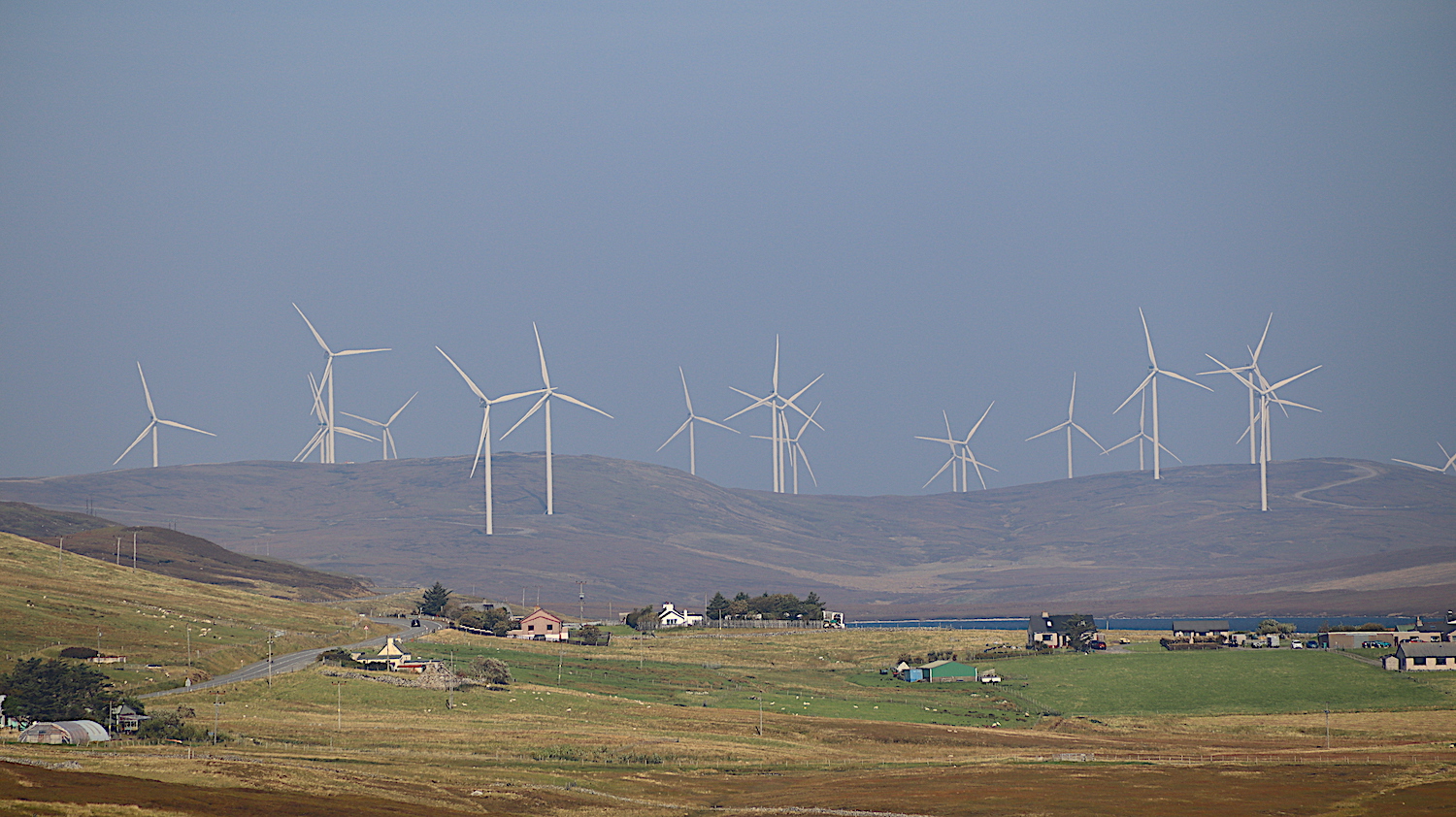
Shetland alone has 443MW of Viking operational, up to 2.8GW of proposed offshore wind, three further onshore wind farms in development, and a second HVDC link planned for 2035. Not to mention overhead transmission pylons, battery parks, HVDC substations. And on the demand side there is ammonia, eFuels, all sorts of clever ideas to subsidy-farm-I-mean-provide-jobs-and-save-the-planet.
The communities carrying the heaviest infrastructure burden are precisely those locked out by the TIA thresholds, stuck behind a connections queue full of developer-led projects, and now offered programme funding designed for English public buildings.
If the answer to “you’re industrialising our landscape so multinationals can export our wind” is rooftop solar on a primary school, it doesn’t neutralise the criticism!
I’ve written about this before, and Reform UK doesn’t need to fabricate grievances here. The structural inequity is real, and the LPP might inadvertently expose it further.
The view from an organised, ambitious, industrious community
We want to do something with the extraordinary wind resource on our doorstep – the same wind that strips the heat and drives up bills through winter to levels most folk could scarcely believe.
Unless something changes (i.e. dedicated grid access for community projects as per Community Energy Scotland’s call), we won’t be able to build generation above 50kW until at least 2035, because the grid queue is full of the projects we’re being asked to host (by then there could be 60,000 times the 50kW generation limit built by commercial developers on the Shetland transmission side, that hasn’t yet been constructed as of today).
We could fit solar panels to a community building, but let’s be honest, that’s not going to transform anything.
What would actually work
I don’t want to just criticise. For communities in England and Wales with grid access and suitable building stock, some of this plan will genuinely help, and that’s fair enough, it’s probably who DESNZ/GBE mostly had in mind when it was being drafted.
“Communities carrying infrastructure burden deserve priority access, not a decade-long queue behind commercial projects.”
But for host communities at the sharp end, what’s needed looks different. We need a meaningful stake in the generation assets already operating around us; not voluntary benefit funds at £5,000 per installed MW, but structured ownership producing real revenue. The mandatory shared ownership offer promised for consultation in 2026 needs to arrive with teeth.
We need grid connection capacity reserved for community-scale generation in host communities. The Community Energy Scotland proposal for community energy to be designated as “needed” within the connections reform process is exactly right.
Communities carrying infrastructure burden deserve priority access, not a decade-long queue behind commercial projects.
We need the TIA threshold in Scotland raised.
And if we’re going to use the term community wealth building, it has to be used properly.
Too late?
The plan arrives when the infrastructure it is meant to build consent for is already being built, and communities feel like they needed meaningful participation five years ago.
Aiming to bolster public support for the energy transition through a scheme that structurally excludes the communities carrying the biggest burden is a fundamental miscalculation in my view.
You can’t build consent retrospectively, and you can’t do it with a plan that offers the windiest, most infrastructure-heavy communities in Britain the least ability to participate.
Local power is self-evidently a good idea. But can the LPP deliver it? Maybe, with more work.
But from Shetland (which is probably irrelevant to UK Government’s masterplan anyway, since it’s full of non-Labour-voting, non-Newtonian people), the answer – for now – is no.
Daniel Gear is the chief executive of Lerwick-based consultancy Voar. This article was first published at Daniel’s Substack here.