
Viewpoint / It’s not that easy being green
As campaigning for the May election to the Scottish Parliament starts hotting up, former Labour candidate and ex-councillor, Dr Jonathan Wills, responds to the recent announcement by the Greens to field their own candidate and argues in this Viewpoint contribution that only the SNP has the power and is capable to implement some of the Green policies


THERE’s something endearing about the Scottish Green Party’s election campaign in Shetland. They have nice, simple wooden signs saying nice, simple Green things like ‘Shetland vs. Corporations – Vote Green’, ‘A is for Aabody’ and ‘Shetland Green Future’.
It’s a sort of evangelical green populism, where complex questions are reduced to nice, simple choices with nice, simple solutions. Yes, it’s easy being seen to be green, but what does it really mean?
Their candidate tells us they’re “no longer a minority”. I rather think they still are, and not only in Shetland. There are reasons for this. Like a lot of people, probably including most SNP, Labour and Liberal Democrat voters, I do support individual planks in the Greens’ platform, but most of us realise the only way to get things done is to elect a government willing and able to deliver them. For example, the Green signs say ‘W is for Wealth Tax’, and ‘F is for Four Day Week’. No decent social democrat could disagree. The question is how to achieve these desirable things. It would help if the Scottish Government had full control over financial and social policy. So where’s the nice, simple Green sign saying ‘I is forIndependence’? It is still Green Party policy, isn’t it? Perhaps the whitewash isn’t dry on that one yet.















Look, there’s no realistic prospect of the Greens forming a government after the Scottish parliamentary election on 7 May. The chance of a LibDem administration is similarly microscopic, although either or both parties might find themselves as junior partners in a coalition. If that happened they’d have influence but they wouldn’t be able to put Green policies into practice without the agreement of other parties.
Another Green placard says ‘J is for Jobs for the Future’. Really? Not Shetland jobs in fossil fuels, apparently. There’s a conflict here between the Greens’ support for campaigns like ‘Just Stop Oil’ and the ‘Just Transition’ policies that the SNP Government and most reasonable folk support as we phase out fossil fuels and switch to wind, solar and other renewable power. If this happens too quickly, what about the workers in oil and gas who stand to lose their jobs? ‘Just Stop Oil’ is a nice, simple Green slogan but what would it mean in practice, for Shetland? There are nothing like as many jobs in renewable energy, once you’ve installed the turbines, the transformer stations and the cables (hopefully, underground). It’ll take a while to retrain and redeploy that workforce in other parts of the economy.
The Greens’ opposition to the new Rosebank oilfield west of Shetland is understandable. The environmental impact assessment was indeed defective. That can be fixed but a deeper problem is this: where will we get the (declining) quantity of oil and gas that we’ll still need while the Just Transition is happening? Sure, we could do without Rosebank and we could even shut down all other oil and gas fields in the UK sector. We could still buy fuel on the world market. But who will dominate that market? Who else but extremist and unpredictably violent authoritarian regimes in places with lax environmental protection laws, such as Saudi Arabia, Iran, Venezuela, Russia and now (alas) the United States of America, to name but a few. Do we really want to rely on them? Or would it be better for national security to have our own supplies? It’s a question too complicated for a nice, simple green-and-white placard.
The technology exists now for renewable electricity to power most of our domestic heating, industry, land transport and short ferry crossings. We ought to move as quickly as possible to that goal, assuming manufacturers can resolve the problem of batteries that rely on environmentally damaging production of lithium and ‘rare earths’– but of course that mainly affects other people’s environments, on the other side of the world.
Unfortunately, the technology is not yet commercially available to electrify long distance shipping, such as NorthLink’s ferries, or the planes that Loganair flies from here to the UK Mainland. How’s our next MSP going to sail to Aberdeen or fly to Edinburgh Airport without marine diesel or aviation kerosene? They’re not, at least not for a long while, maybe 30 years, during which we’ll still need some oil and gas from somewhere.

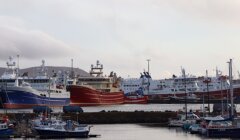
Photo: Shetland News
If we did ‘Just Stop Oil’ now, world trade would be throttled because tankers, bulk carriers, container ships and wide-bodied freighter aircraft would no longer have any fuel. If Greens really want this they can try making the argument for it, I suppose. It could mean most of us going back to a 17th century lifestyle (plus solar powered airships, perhaps). The debate with our modern-day ‘Diggers’ and ‘Levellers’ should be interesting.
Oh, and where will medical plastic items for our Gilbert Bain Hospital come from, if not from oil and gas derivatives? Are alternative, plant-based plastics available and affordable? Maybe a Green doctor could tell us? What are the Green policies on higher taxes for plastic packaging and removing taxes from recyclable packaging? That really would hurt the oil companies. Full, practical details, please…
We’re told we should put Shetland before corporations, another nice slogan but, unlike the Green evangelists, the SNP Government has to be practical. That means dealing withcorporations while not taking orders from them. Ever since the Tories’ corrupt privatisation of many publicly-owned enterprises (for example, BP, Britoil, British Gas and the Hydro Board), private corporations have supplied the fuel and power to keep our society going, including our renewable electricity. Like them or loathe them, corporations also make the vast variety of items we buy in local stores, and those essential consumables that Shetland NHS uses every day. And how many folk in Shetland work for a corporation? Quite a lot.
No government in power for almost 20 years can please all of the people all of the time. But the SNP, despite its mistakes, has tried to govern as a mainstream social democratic party and does its best to implement Green policies where possible. John Swinney and his ministers have shown they’re willing to listen to serious environmental proposals from other parties – remember that sensible SNP/Green policy on recycling plastic bottles? But it was blocked by Westminster, under orders from corporations. That tells you something: ‘I’ is indeed for Independence.
John Swinney and his ministers have shown they’re willing to listen to serious environmental proposals from other parties – remember that sensible SNP/Green policy on recycling plastic bottles?
So, things are not as simple as those nice placards suggest. It’s actually not that easy being green. It’s complicated, as the experience of the SNP in government shows, sometimes with Green Party support, sometimes without.
If you want an effective Member of the Scottish Parliament, with real influence on the majority party’s environmental policies, rather than a member of a fringe party bleating from the sidelines for another five years, it might be an idea to vote for the SNP candidate on 7 May, whichever way you vote in independence referendums. Unlike the others, she could get nice Green things done.
Or you could vote for my good friend Alex, and get…Emma MSP.