Revitalising Shetland – devolve power to communities and stimulate public debate
In this ViewPoint contribution, former Labour parliamentary candidate Peter Hamilton looks at ways of revitalising public life in Shetland with the ultimate aim of finding ways to share local wealth more equally

Finding “the right way to plan for Shetland’s future” could herald a new era. It is rare that a news story is worth revisiting but Work to begin on forming next Shetland Partnership Plan (Shetland News, 19 May) is one such thought provoking piece, writes Peter Hamilton.
In it, Gary Robinson, as chair of the Shetland Partnership, says the islands’ next 15-year plan would be developed against a backdrop of challenges including the working-age population, the growing impact of climate change and persistent inequalities affecting the quality of life.
These “persistent inequalities” should give oil-rich Shetland cause for reflection. Some folk haven’t been getting their slice of the cake.
There is evidently a fear of there being too few younger folk likely to stay and make their lives in Shetland, and also that there are too many folk on the margins of Shetland society, increasingly priced out of full participation in community life.






















Beyond putting the usual suspects into a room for another chinwag, how might such fears best be addressed?
Some indication was once given in Deprivation and Social Exclusion in Shetland, a powerful piece of research conducted to inform local policies directed at lessening deprivation and social exclusion, which contains many valuable insights, but is likely now gathering dust.
The launch of this new phase of community planning comes at quite an interesting time in Shetland. It arrives not just on the heels of one of Shetland’s biggest political protests: the plight of the Scalloway pool, but also following the election of Shetland’s first SNP MSP, an ardent supporter of decentralisation.
Hannah Mary Goodlad plainly understands that giving folk more control of their own affairs could revitalise Shetland. She has seen different approaches work elsewhere, including in Faroe and Norway, and obviously yearns for Shetland to overcome ingrained cultural attitudes – the darker aspects of Shetland’s version of Janteloven, which are known across Scandinavia to keep the people quietly in their place, and which, as a result, hold folk back and enable inequalities to persist.
The news story ended with Scalloway Community Council chair Lawson Bisset saying the same concerns regarding the working age population, climate change and persistent inequalities regularly come up for discussion at meetings, adding: “It’s good to see community councils sitting at the same table as the bigger partners and treated as equals in this. That’s the right way to plan for Shetland’s future.”
I’ll agree that is part of it, but I think there is more to add.
More recently, Lawson’s sentiments have been echoed by Andrew Archer, the chairman of Tingwall, Whiteness and Weisdale Community Council, who rightly complains: “Across many communities there is a strong and growing feeling that these [major energy] developments are being done to us rather than with us”, adding “Local communities do not feel listened to or meaningfully involved in decisions that will reshape the places where we live.”
Energy projects should be stopped until ‘coherent plan’ in place, community council says (Shetland News, 29 May).
Well, quite. But if we go back to those folk less likely to be present at community council meetings, the socially excluded suffering the persistent inequalities, struggling to make ends meet, we see something similar.
That Shetland is simply not working fairly for everyone is the product of decades of local policies favouring the haves and ignoring the have nots.
If you are on the margins, up against it for whatever reasons, your voice is far less likely to be heard. The local folk who were not protesting to keep Scalloway pool open include those who can’t afford to get there or indeed even to use it. Let’s remember them too.
Within the many organisations which are involved in the Shetland Partnership are Shetland’s oil trusts, Shetland Arts, the Amenity Trust and the Recreational Trust, all of which have some ability to help poorer folk in different ways. Additionally, there is their main funder, the incredibly wealthy Shetland Charitable Trust, which additionally provides significant funding for various good causes… and yet there remain those “persistent inequalities affecting the quality of life”.
Most folk will agree charity is a good thing, but different things are achieved under its name. You might gift money to help a homeless person. Alternatively, you could give to Shelter, a campaigning charity dedicated to ending homelessness. Some charities accept the poor will always be with us, and should be given the occasional handout. Others, like Oxfam, oppose poverty and want to change the society that allows it. Who secures access to resources held in trust, who gains, who doesn’t: these are inherently political questions. Neglecting this secures persistent inequality, and it is being neglected.
Like it or not, consciously or not, the focus and approach of Shetland’s trusts do not address those inequalities. “Shetland more active, more often”, “Celebrating and championing Shetland’s cultural and natural heritage”, “Bringing people together through creativity across Shetland” and “Improving the quality of life for people living in Shetland” may sound universal in scope, but these aspirations are plainly not working for all.
The “let them visit Mareel, the archives or their local leisure centre” approach isn’t reducing the numbers experiencing fuel poverty or depending on the food bank.
Whether or not the Scalloway Pool is reopened or not, Shetland’s oil trusts lack accountability. They almost always take decisions about what to do with the people of Shetland’s oil money without consulting them. Those who like sport have ensured there is sport aplenty. Those who like the arts, likewise. But if your most pressing concerns are how to stay warm and fed, well, tough.
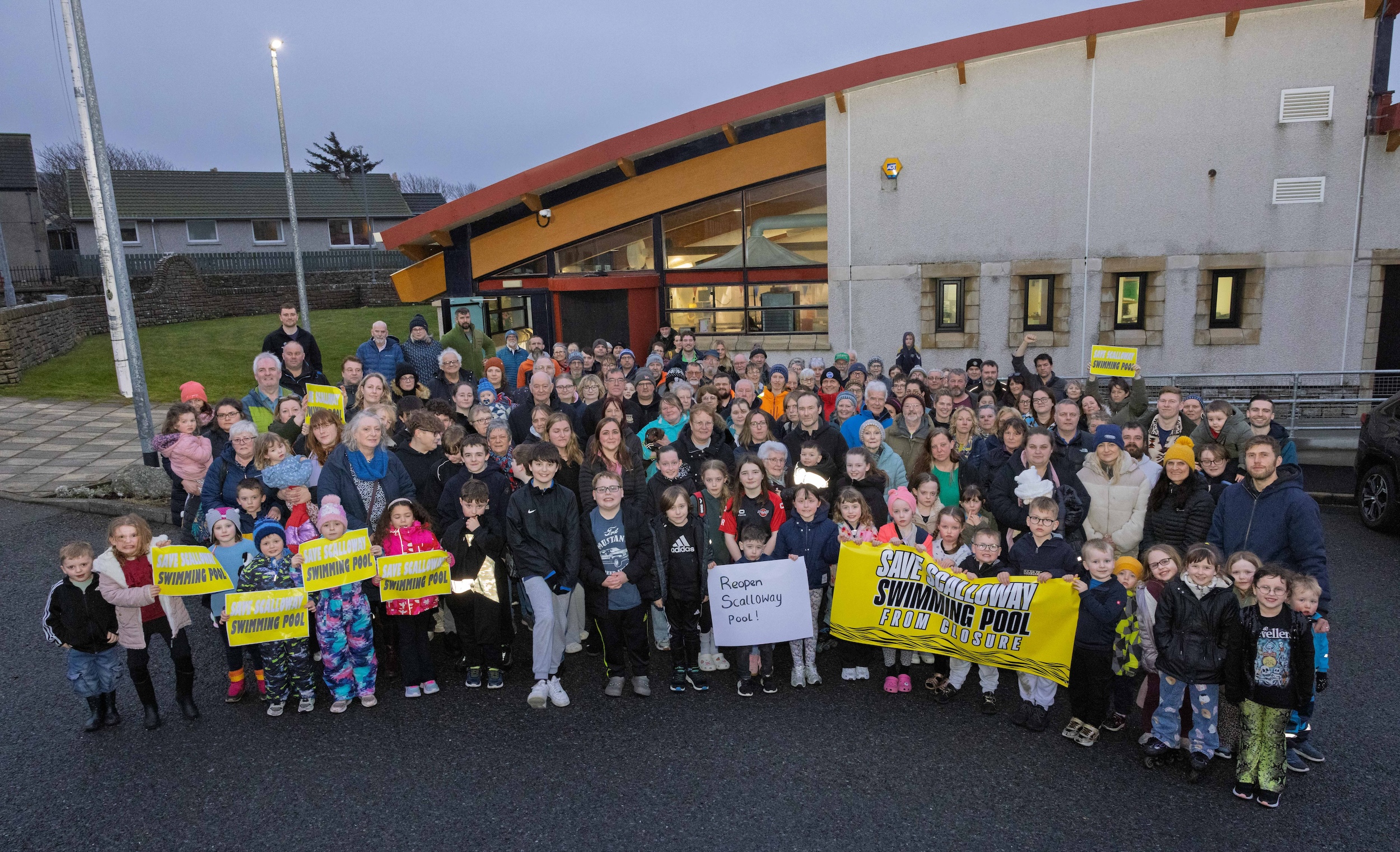
Photo: Ben Mullay
Even if the trusts did consult, how do we guarantee that those suffering persistent inequalities would get a fair hearing? Remember, the oil money was set aside for social disturbance payments. The persistence of the inequalities relates in many ways to the social disturbance of the oil era which put money in many pockets, but not all.
The construction phase was always going to result in increased drug and alcohol consumption, broken homes, and domestic violence; and that long shadow hangs over the present generation, now compounded by new challenges including rapid increases in the cost of living, Airbnb’s reducing housing stock and increasing rents (further enriching the haves at the expense of the have nots), pervasive incel influencers and ’county lines’ drugs operations folk would need help to escape.
There was, for a brief time, an active team of community workers in Shetland, working within an approach called Action Research, which was specifically designed to empower the powerless and secure greater fairness, or equity as it is also known. There have also been times when young people had far more involvement, greater attention and support.
As its name might suggest, a vehicle that could make a substantial impact, the Zetland Educational Trust, has existed for well over 60 years. It has been managed by Shetland islands Council, and although it remains semi-active, it punches far below its potential weight. With an amended constitution and support from an enlightened Shetland Charitable Trust, its potential is enormous.
Education, when freed from the restrictive bind that expects it to only to direct people into employment, has tremendous transformative capacity. Even if it means reducing the expenditure of the other subsidiary trusts, Zetland Educational Trust should at the very least be put into a position to restore Shetland College as a provider of hope and second chances, as, in more enlightened times, it was firmly expected to be.
All this becomes possible if Shetland Charitable Trust were itself to embrace its ethical responsibility to actively counter deprivation. An ethical disbursement strategy is decades overdue. I’ve had a change of mind since penning A Shetland Moment (Shetland News, 5 October 2025). Previously I thought there should be elections to Shetland Charitable Trust. I’ve since been thinking that each trust needs some kind of advisory body, with members elected, bringing trustees, and policy, closer to public need.
At the very least, a “Friends of” body to act as a bit of a sounding board for each trust, and maybe train up future trustees, seems like a no-brainer. But beyond those, is there another way to close the gap between those who are meant to benefit and the trustees (and more so, their officers) who decide? I think there is.
Having wrestled with this long enough, it seems fairly clear what Shetland’s political rejuvenation now requires. Shetland Charitable Trust, and the other trusts it funds now, and could fund in the future, should have a far closer relationship with the Association of Shetland Community Councils. It would be to their, and everyone’s huge benefit, were this so.
Indeed, for a relatively minor sum, SCT could fund a number of very useful things in partnership with community councils and the association, including engaging with local folk and developing an anti-deprivation strategy.
Empowering community councils to act in partnership would increase their relevance. Doing so would aid community councillor recruitment.
Another opportunity involves local development trusts, several examples of which already exist in Shetland. They could have a very valuable part to play. Set up with charitable status, they could receive SCT funding, employ youth workers and employ community workers to ensure marginalised groups are empowered. Even just trialling such an approach could help close service gaps for the rural poor, young families included.
An annual trusts users’ conference could build and strengthen links between the community and community councils, the community development trusts, and the Friends of the arts, recreation and amenity trusts. Such a conference would offer opportunities to celebrate the work of all these groups, identify what has worked well, exchange experiences and help the trusts review and develop their strategies for the years ahead. Injecting ideas from outwith Shetland would be worthwhile, too.
Young people’s voices could easily be included, particularly were the arts, amenity, and recreation trusts to develop their own youth strategy. Each could have its own youth development board, youth worker and community worker actively working to secure equitable access. Young artists, musicians, singers and actors, archaeologists, rangers and future athletes and team players, and those Not in Employment, Education or Training, could each be given opportunities to have more of a say.
Democratic participation is not a once in four years event. It has to be nurtured to be successful, for more ideas to flourish, for more autonomy, ownership and control.
Opportunities have been missed to reduce costs and increase the spending power of each of these trusts by bringing in volunteers and undertaking eco-investments to reduce electricity bills and carbon footprint. Each trust should have an environmental strategy and participation strategy as well. Community development workers could play a central part in this.
Community development trusts, in close consultation with their community council partners, could be given short life discretionary budgets from each trust in turn, allowing arts, amenity and recreation to be improved and celebrated in each of Shetland’s distinctive localities over a rolling programme.
What would each community choose to do with £15,000 to spend on promoting the arts or meeting the objectives of the amenity or recreation trusts locally once every five years? Such flourishing doesn’t all have to happen everywhere at once to have a lasting impact. The 15 year-duration of the next Shetland Plan provides time enough for all of Shetland’s communities to have contributed to Shetland’s renaissance in different ways.
Give local development trusts a worthwhile budget, increased responsibility and both they and partner community councils will flourish, with positive knock-ons for the rest of Shetland society into the future. The achievements of Glenfarg Community Transport ( https://glenfargct.co.uk) in responding to unmet needs offer a glimpse of what this decentralised model might achieve. Community development trust hubs could also host family centre and other outreach and provide different means of countering rural disadvantage and persistent inequality.
Shetland needs to move on from a past that has been hindered by various examples of mismanagement which have been enabled by a reluctance to challenge or rock the boat. Indeed, that history may be partly responsible for what now looks worryingly like a stifling lack of ambition and imagination, sometimes bordering on fatalism.
The sense of impotence over energy developments, in contrast to the determination with which the Zetland County Council approached oil, is palpable, but the same lack of ambition seems to have infected large areas of public discourse.
Shetland has the resources to do better, much better, but it needs to make far better use of the mechanisms it already has and improve its capacity to learn and share where the present fabric is lacking.
It needs to look at every kind of opportunity, and not pin all hopes on the next “big thing”. Shetland will be a better and more appealing place if folk embrace the widest range of opportunities and nurture the corresponding talents.
Where to start? Empowering the community councils to work in meaningful and active partnership, as critical friends when needed, would allow for the oil trusts to be publicly held to account should the occasion arise. Public comment from the Association of Shetland Community Councils should never be ignored. A quiet word first should suffice when trust is being abused, but fundamentally the need for better checks and balances across Shetland’s trust landscape was apparent even before the end of Shetland Development Trust. Ignoring that need has been expensive in many ways. Transparency has worsened too.
Fundamentally, there need to be meaningful checks and balances if we are to know what is being achieved in the name of “improving the quality of life for people living in Shetland”. Shetland Charitable Trust needs to inject a test of fairness into that goal, and the other trusts need to demonstrate that they, too, buy into that. In short, they need to focus on improving the quality of life fairly for everyone living in Shetland. This focus on fairness will entail a far more open set of relationships between all the main players and between them and the communities they serve. It will require that projects be tested against that central aim and rejecting those that don’t support it.
And although it would be daft to pin everything on energy, it’s clearly a major opportunity and challenge, and it needs a far more considered approach that will indeed ensure that things are not done to folk, but with them and ideally by them. There needs, across the board, to be an end to buck-passing, of which the Scalloway pool case is a painful example, made worse by the appalling failure to consult the community.
In considering this, I can’t help reflecting on what Jo Grimond MP would have made of our present condition. His unwavering support and advocacy for what the Zetland County Council managed to achieve in the 1970s was absolutely crucial, but the whole enterprise would never have got off the ground if the people governing Shetland at that time had not been driven – and that is the operative word – by an overwhelming, uncompromising desire to do the very best for a community that had only just recovered from years of decline.
Today’s challenges are very different but meeting them depends just as vitally on the kind of leadership shown back then.
I hope that the approach I’m suggesting would also make the best of Shetland’s human capital, which, as globally renowned economist Amartya Sen explains in his book Development as Freedom is the best way to secure sustainable economic growth.
In it, he shows public debate matters to securing the best ideas are brought forth, and promoting equity, aka fairness, is the actual foundation of the much-envied Scandinavian economic model. Imagine if fairness had been the main driver behind Viking energy: local voices heeded, fewer turbines. less fuel poverty, more community benefit in different forms. What a waste: but just one more example of partisan decision making with predictable results. Vested interests triumphed, public benefit sidelined.
Weakened local politics, increased inequality and community division have been inevitable byproducts of hosting Sullom Voe Terminal as those with the ability to do so have got to the banks first and laid up all the wood they might want, and more.
Revitalising Shetland in the ways I’m suggesting would strengthen institutions and breathe new life into local democracy, hopefully helping to diminish the cynicism about public affairs which is demonstrably a threat across not just Shetland but much more widely.
It would create a pathway to a society in which nobody felt excluded, neglected or unheard. It would provide multiple opportunities for improving the quality of life of those suffering the persistent inequalities and social exclusion, who have too often been left aside. That in turn would see increasing cycles of equity, of fairness, with different solutions being given consideration spurring a greater variety of opportunities, improving the likelihood of young folk wanting to and being able to bide on, instead of moving south.
Shetland has the means. Its best days could indeed lie ahead.