

Reviews / ‘These stories have been sitting on the shelf for centuries’
Author Paul Moar rediscovers the forgotten heritage of the local trolls

AS THE insanity of global politics and world events spirals into chaos and uncertainty, there is one comfort that can bring hope and joy amongst dark times – the sanctuary we create when we read books, writes Alex Purbrick.
Now more than ever we need stories in which we can reimagine the world, to see our imaginations as gateways to our inner worlds where folklore, our ancestors and the rich myriad of oral culture weaves us back into the fabric of our land, creating an intimate, interconnected and colourful storyscape where magical beings, animals and the elements of the natural world accompany us on our life journey and lend us a sense of belonging.
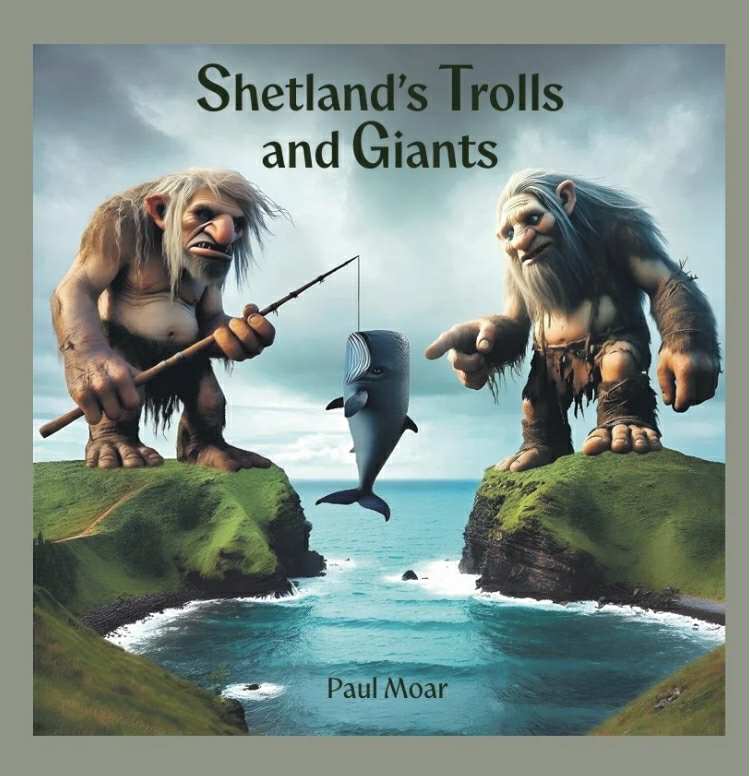
As we move through 2026, the National Year of Reading, there is one book that is an essential read to enable us to reimagine Shetland’s magical landscape and that is Shetland’s Trolls and Giants by Paul Moar.



A born and bred Shetlander, Paul has been interested in Shetland’s heritage for many years, especially Nordic place names, having previously published the book Shetland’s Old Norse Personal Names in 2007.
He feels the Norse place names are the “living link to our heritage” and a way for folk to reconnect with the landscape and the stories attached to the old Norse words.
Although he considers himself “a regular working man” employed at the Lerwick recycling facility, Paul spends most of his free time poring over old maps of Shetland and Shetland folklore books at the Lerwick library.
“I love going to the library on a Saturday, especially during the winter months, and one of the things I really enjoy is looking at the big scale maps and the different names on the maps,” he sums up his passion.
Become a member of Shetland News
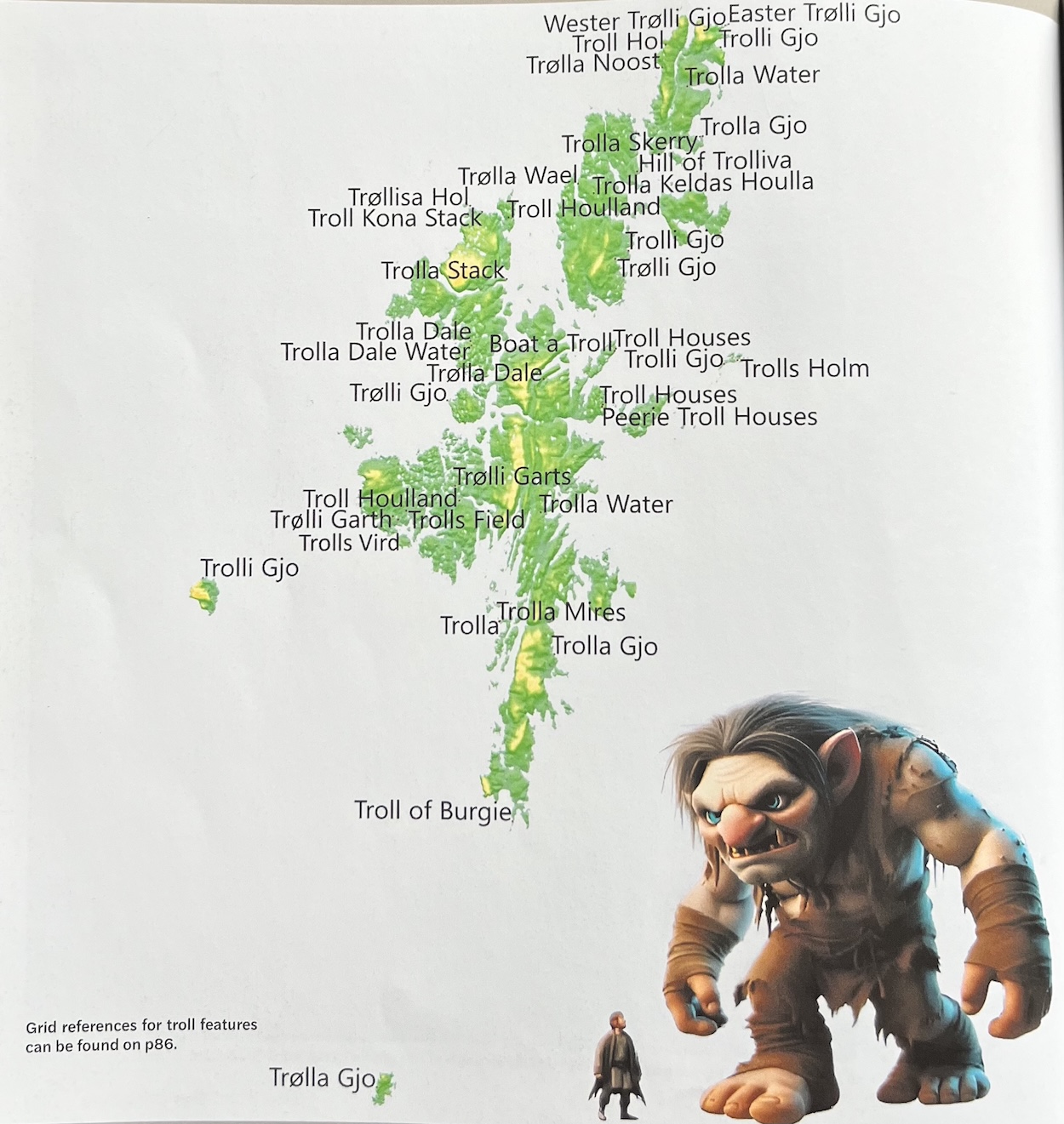
One day as he was looking through the old maps he noticed a troll place name. This felt like a lightbulb moment as he realised, ‘wow! We have troll place names here in Shetland!’ Paul had heard of many troll place names in Iceland, Faroe and Norway but never in Shetland.
In Scandinavia, trolls are very different beings to the peerie trows who are very well known in Shetland folklore.
Trolls are the giants. Ancient supernatural beings that inhabit the wild, primal forces of nature and as Paul discovered, the troll stories have not been talked about in Shetland for a long time.
So far Paul has found evidence of 37 troll place names in Shetland, ranging from the far north of Unst to the far south in Fair Isle. Names such as Trolli Gjo are common from the old Norse word, Gjogv,which means geo or coastal ravine, and Trollisa Hol meaning the troll’s cave.


















He has unearthed wonderful stories of Grottie Finnie, the Fair Isle troll and Geitir the West Sandwick troll as well as the lesser-known stories of troll wives known as guykerls or gygr’s.
These are giantesses who were very powerful and lived in the hills and cliffs around Shetland who were especially fond of kirning the sea in their giant cauldrons. An example being the Gore’s Kirn on the south-east coast of Bressay.
Paul discovered Gryla, a Norse giantess, through reading the Faroese linguist Jakob Jakobsens’ books as well as the insightful paper written by UHI Shetland lecturer and researcher Dr. Andrew Jennings, The Giantess as a metaphor for Shetland’s Cultural History.
Paul mentioned he was watching the Icelandic news and saw a map of Iceland where there are many Gryla place names and this intrigued him because he knew Gryla was well known in Iceland and Faroe but not so well known in Shetland.
Other giantesses have appeared in his book such as Lukkie Minnie from Fair Isle, and the twa auld wives fae Whalefirth, in Yell, to name a few.
Probably one of the more well-known giants featured in the book is the Da Lang Kames Giant who left his notorious two-toed footprint at Petta Water. A drone photo of his footprint brilliantly shows the outline of his toes, taken at a time before wind turbines dominated the landscape.
The highlight of this book is Paul’s use of photographs to identify sites of giants and trolls throughout Shetland. Over the past four years he has wandered the length and breadth of the isles to find the stones, skerries and geos that are the hall marks of the giants and trolls’ legacies.
Before industrialisation of Shetland folk would have placed huge importance on a knowe, a standing stone, an unusual skerrie or mark in the land and sea and woven a story around that site giving it an animate quality and character.
Every piece of the land was inextricably tied to the folk and their everyday lives forging an intimacy that is sadly disappearing as we tear up the land in the name of progress.
Accompanying the photos are illustrations of the trolls and giants. It wasn’t financially viable to hire an illustrator for the book and therefore he used AI to bring the giants to life.
“I wanted to show for example Troll Kona Stack in Uyea, Northmavine, which looks like a hag giantess and the illustration shows that perfectly,” he says.
Ultimately this is a book for young and old alike. An easy read with multiple layers of depth and magic in the stories Paul has shared.
“I want to bring this book to everybody and make the stories accessible to everyone across Shetland,” he sums it up.
“I want folk to enjoy our troll/giant folklore and our heritage. These stories have been sitting on the shelf for centuries. It’s time to take them off the shelf and I also hope they inspire our young Shetlanders to learn our heritage.
Shetland’s Trolls and Giants by Paul Moar is released on Saturday 4 April.There will be a book signing by the author at The Shetland Bookshop, Lerwick from 2-4pm.
Become a member of Shetland News
Shetland News is asking its readers to consider paying for membership to get additional perks:
- Removal of third-party ads;
- Bookmark posts to read later;
- Exclusive curated weekly newsletter;
- Hide membership messages;
- Comments open for discussion.
If you appreciate what we do and feel strongly about impartial local journalism, then please become a member of Shetland News by either making a single payment, or setting up a monthly, quarterly or yearly subscription.