

Reviews / Community orchestra offers ‘joyous and thrilling’ experience

HOW FORTUNATE we are in Shetland to have a thriving community orchestra, which gives us the opportunity to access a live orchestral experience, writes Chris Horrix.
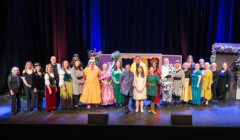
Those were my feelings as I listened to Shetland Community Orchestra’s spring concert at Quoys Church on Saturday evening, and also played with them for one of their pieces. And what a joyous and thrilling occasion it was.
The enthusiasm of the players under guest conductor Susie Dingle’s baton, was infectious. Their programme, with three pieces of music written in the 19th and early 20th century, made for an extremely enjoyable evening of music.
The opening piece was the overture to The Italian Girl in Algiers by Rossini, a master composer of operas. His sense of drama and comedy sparkled in the orchestra’s performance.
They tackled the occasionally demanding writing with spirit, sharing with us the comedy of the sudden orchestral outbursts, with some vigorous playing by the percussion section. The whirlwind ending, with the orchestra going hell for leather to a rousing finish, was a great start to the evening.




















The second piece on the programme was Ravel’s Mother Goose Suite, originally written as a piano duet and then orchestrated by the composer. This piece is fairy-tale telling through music, with a luminous shimmering atmosphere created through rich sounds and orchestral colours.
The orchestra’s performance did not disappoint, drawing the audience in to this experience. The first movement was a calming lullaby, describing the Sleeping Beauty.
In the next movement, we wandered through a forest, with the sound of bird calls between flutes and violins.
Then in The Empress of the Pagodas, we were transported to the east with oriental sounds and scales, prominent in the xylophone and celesta playing, and what seemed like a game of tag between the orchestral parts.
Become a member of Shetland News
This video below shows a clip of the orchestra’s rehearsal in the afternoon.
We needed to wait for the start of the Conversation between the Beauty and the Beast, while the youngest member of the orchestra, Andrew Laurenson, fitted the huge contrabassoon, whose music represented the Beast, around him.
We were told that the instrument had only arrived the previous day, but his confident performance provided the necessary contrast with the beautiful lilting and dream-like waltz representing Beauty, ably played by the clarinets. As in all the best fairy stories, the movement ended with the portrayal of the Beast transforming into a handsome prince.
The final movement, The Fairy Garden, produced delicate and tender playing by the orchestra, building to a gorgeous crescendo, with a feast of glissandi on the celesta. The shimmering sounds made by the orchestra echoed around the hall and it wasn’t difficult to imagine the Sleeping Beauty waking up into the enchanted musical world the orchestra created. A magical performance indeed.
The final musical offering was Mendessohn’s Scottish Symphony. This is a musical giant of a piece. Mendelssohn first started its composition as a young boy of twenty on a visit to Scotland, and then finally completed it a few years before his tragically early death at the age of only thirty-eight.
With a title like this, one might expect references to Scottish tunes and bagpipes, but instead it is a much weightier and expansive depiction, referencing Scotland’s landscape, culture and heritage. Its performance was also a huge undertaking for the orchestra, requiring stamina and concentration, as well as skill.
Under the reassuring conducting of Susie Dingle, they produced a performance that drew the audience into the dramatic story-telling and sound picture of the music.
The solemn opening of the first movement, reminding us of the majesty of the mountains and our wild landscape, gave way to an impassioned stormy section, with thundering timpani and thrilling sounds, particularly from the wind and brass section, before returning to a calmer sunnier pace at the finish. It seems that Mendelssohn must have experienced Scotland in all weathers.
The Scherzo is the nearest we hear in this symphony to actual folk songs, with scampering strings and gleeful dance-like tunes on the clarinets, suggesting a celebratory ceilidh. The slow movement, with expressive playing from the wind section, and a heart-rending melody on the strings, was mellow and thoughtful. Much like a good golden whisky, an experience to be enjoyed and savoured.
Then the opening of the finale, originally described by Mendelssohn as war-like, but definitely referencing the stormier and harsher elements of Scotland.
The robust and confident playing of the orchestra included the audience in the experience, with weighty sounds from the brass ringing out. The hymn-like ending was a celebratory closing section to this musical journey. The enthusiastic playing of the orchestra took the audience on that journey with them.
To hear live classical music is an experience not to be missed, particularly when Shetland has a community orchestra as good as ours. If you missed this performance, you can hear members of the orchestra performing with the community choir at St. Columba’s Kirk on 16 May, and at the orchestra’s next concert in Quoys Church on 3 October.
Become a member of Shetland News
Shetland News is asking its readers to consider paying for membership to get additional perks:
- Removal of third-party ads;
- Bookmark posts to read later;
- Exclusive curated weekly newsletter;
- Hide membership messages;
- Comments open for discussion.
If you appreciate what we do and feel strongly about impartial local journalism, then please become a member of Shetland News by either making a single payment, or setting up a monthly, quarterly or yearly subscription.