


Transport / SIC to make some of its electric vehicle chargers open to the public

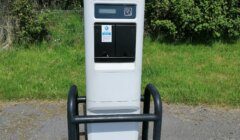
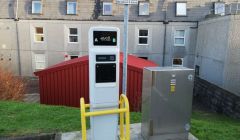
SHETLAND Islands Council is to make some of its staff electric vehicle charging points accessible to the public.
This would be at the council’s discretion, with a meeting hearing that fleet chargers at locations like depots or quarries would be off limits.
But there remains a recognition that home chargers would provide a cheaper alternative for local residents.
Environment and estate operations manager Carl Symons said that expanding access to the public could help people who cannot install chargers at home, including people in flats for example.
It all comes as the public charging network gets set to change service provider from ChargePoint to ScottishPower.
A report to members of the SIC’s environment and transport committee on Monday said the majority of the council’s fleet charge points are currently on the ChargePoint back office too.
There will be an opportunity for the SIC’s fleet points to be migrated separately on the same rates.




















Symons said one aim is to have the availability of chargers mapped out online.
“With utilisation rates on charge points relatively low this is a good time to review different options for the use of fleet charge points to see how it works in practice,” a report to councillors said.
According to ChargePlace data there is 5.8 per cent utilisation across the public network in 2025/26 to date.
It is estimated that it will cost the SIC £8,900 to run the 28 public charge points in 2026/27, with the cost for its own fleet system – with 22 chargers – around £9,300.
In the next financial year the cost of using the public network will rise to 52p/kWh for rapid charging and 43p/kWh for a fast charge.
Based on current usage the anticipated income from public chargers, minus transaction fees, is estimated to reach £90,000.
Become a member of Shetland News
Meanwhile moves will be made for Scotland’s island authorities to work on a business case for Transport Scotland which could unlock £2 million of investment for the expansion of charging networks.
Symons said Shetland’s indicative budget from this would be £473,000.
In 2023 Argyll and Bute Council, Comhairle nan Eilean Siar, Orkney Islands Council and the SIC were brought together under a shared scheme focused on “de-risking” existing operations and then expanding the regional charging network.
Symons said an aim here is to have a “commercially investable network” which is more financially self-sustaining over time, and could attract private sector involvement where appropriate.
But Symons said the SIC has had no commercial interest in network development in Shetland.
With charge points getting information from mobile data, he told Monday’s meeting that the largest number of complaints on the existing network relates to signal issues.
“It is something we’re actively trying to eliminate,” Symons said, adding that the SIC is looking at trying to have as much maintenance on charge points done locally.
He said the SIC is investigating the idea of “hardwiring” networks so it is not reliant on mobile signal, but there remains questions over feasibility.
Meanwhile the meeting also heard that the SIC is looking at home charging options for council employees who take vehicles – such as a van – home.
The council is also investigating the possibility of a “salary sacrifice” scheme for electric vehicles.
Symons meanwhile told the meeting that electric vehicles are now a “viable buy” for the SIC.
He highlighted one recent procurement round where the estimated cost of electric vehicle cars was £28,000 or £29,000, but once grants and deductions were applied they came to around £19,000.
But he said an unknown about expanding electric vehicles in the SIC fleet is the electricity network, and whether the grid can support additional infrastructure.
Meanwhile with utilisation of less than six per cent, Shetland West councillor Mark Robinson questioned what justification there was for expanding the network.
Symons said if charge networks are not put in place the SIC could “fall behind” and would risk not making use of funding.
He also said Scottish policy was directed towards chargers being installed in strategic locations, such as ferry terminals.
Meanwhile development committee chairman Dennis Leask said his biggest concern was the cost, and he pointed to the “abundance of renewable energy” in Shetland.
Become a member of Shetland News
Shetland News is asking its readers to consider paying for membership to get additional perks:
- Removal of third-party ads;
- Bookmark posts to read later;
- Exclusive curated weekly newsletter;
- Hide membership messages;
- Comments open for discussion.
If you appreciate what we do and feel strongly about impartial local journalism, then please become a member of Shetland News by either making a single payment, or setting up a monthly, quarterly or yearly subscription.